🇰🇷 Kakao counts 813 derivative models of its open Kanana AI, third in Korea
In brief
- 📊 By Kakao's own count, 813 external Hugging Face repositories build on its open Kanana models (as of 16 November).
- 🥉 That puts Kanana third among Korean models, behind Upstage's Solar (1,830) and LG's Exaone (1,056).
- ⚠️ The figure includes format conversions and training snapshots; it does not measure finished products.
- 🔊 Kakao plans to release an audio encoder and the omni model Kanana-o before the year ends.
📊 South Korean internet group [Kakao](https://www.kakaocorp.com/) has counted how often outside developers reuse its open AI models. According to the analysis, reported by the news agency Yonhap, the Hugging Face platform held 813 repositories by external developers building on Kakao's Kanana model family as of 16 November. The makers' own official repositories are not counted. 🥉 Among Korean models that is third place: Solar from the start-up Upstage leads with 1,830 repositories, followed by Exaone from LG AI Research with 1,056. Far behind come SK Telecom's A.X (236), NC AI's Varco (190) and Naver's HyperCLOVA X (183). ⚠️ The figures are Kakao's own count and only an indirect measure: the repositories also hold intermediate training checkpoints and versions converted for other runtimes. They do not say how many real applications result. They do show how actively developers build on Korean base models. Kakao announced that it will release an audio encoder and the omni model Kanana-o, which handles text, images and speech together, as open models this year.
🔎 How the count was made. Kakao searched Hugging Face for the main Korean models and removed the repositories the developers had created themselves. A repository there is the place where model files, instructions and descriptions are published together. By Kakao's account it left out copies with identical weights and runtime settings and uploads explicitly marked as plain re-uploads, but counted versions in other file formats and models adapted for other purposes. There is no independent recount.
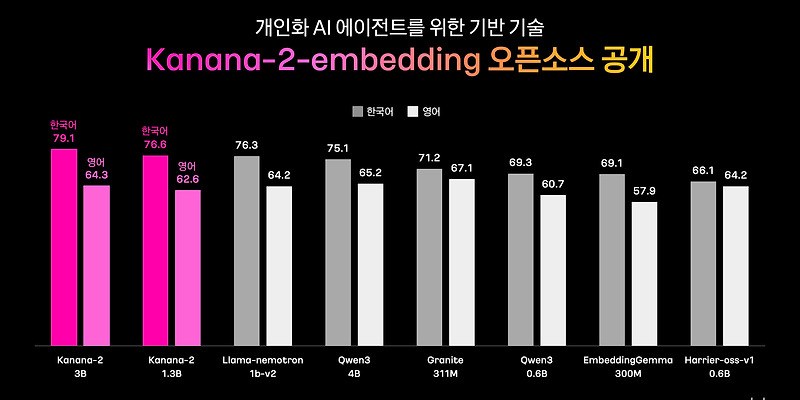
🧩 What Kakao has opened so far. Since February 2025, starting with three small language models, Kakao has released 30 AI models and components as open source, Yonhap reports. The focus is on small and mid-sized models with 1.3 to 8 billion parameters and on mixture-of-experts models, in which only part of the network computes for each request. That is meant to let developers with little computing power experiment with them. Most recently, on 29 October, Kakao put two embedding models for meaning-based search (Kanana-2-embedding, with 3 and 1.3 billion parameters) on Hugging Face under its own Kanana Open License, which also allows commercial use.
🛠️ What developers use the models for. Kakao's review of the outside repositories shows many everyday uses: chat in the voice of a particular character, diary entries for the phone, translation between Korean and English. Other models target specialist fields, such as Korean maths problems, definitions of legal terms, medical exam questions or questions about listed companies' disclosures. There are also research projects for agents: one turns natural-language questions to an enterprise resource planning (ERP) system into database commands, another breaks requests to a university administration into step-by-step plans.
🔊 What comes next. So that developers can also build with speech and images, Kakao wants to publish an audio encoder, which turns spoken language into a form an AI can use, and Kanana-o by the end of the year. The omni model, which Kakao presented in May 2025, understands text, speech and images at once; it has not been available as an open model so far. A Kakao representative told Yonhap that the open Kanana models are meeting developers' ideas and leading to new uses, and that the company will keep releasing models and core technology.
🌏 Why it matters in Korea. Yonhap places the figures in a race in which Korean companies are improving their own models. When individual developers and small firms can adapt an existing model with their own data and expertise, they do not have to train one from scratch. Besides a model's raw performance, how many services are built on it and used in practice becomes a measure of its competitiveness.