🚦 Klagenfurt switches on an AI traffic light that spots pedestrians and talks to cars
In brief
- 🚦 Since Thursday a traffic light on Villacher Straße in Klagenfurt has been running that the city calls Austria's first AI-controlled system with pedestrian detection.
- 👣 Sensors spot people waiting and switch to green; the push button stays but is no longer needed.
- 📡 Via Car-to-X radio it talks to equipped cars and is meant to give KMG city buses priority.
- 💶 It cost 160,000 euros; the city says no personal data is stored.
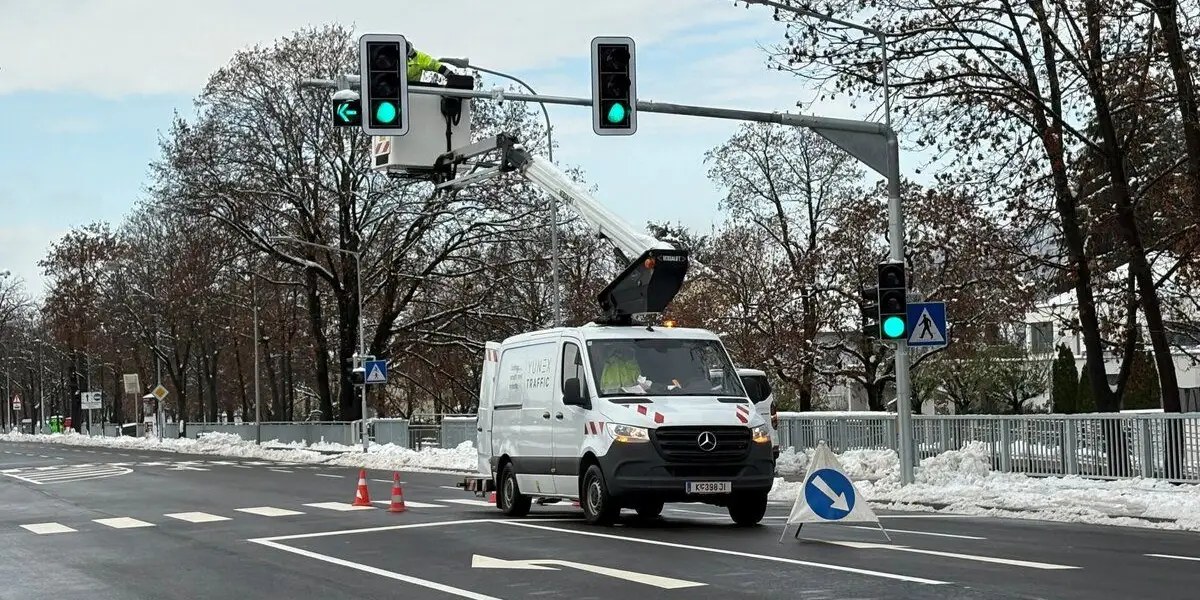
🚦 Klagenfurt, the capital of the Austrian state of Carinthia, switched on a new set of traffic lights on Thursday, 26 November, on Villacher Straße next to the newly rebuilt Heinzelsteg footbridge. The city administration calls it Austria's first AI-controlled traffic light with pedestrian detection. Optical sensors recognise people who want to cross and can turn the light green on their own. The usual push button remains, but nobody has to press it any more. According to the city this mainly helps people with limited mobility. 📡 The system can also talk to suitably equipped vehicles over Car-to-X radio (C2X), for example to warn them about an accident nearby, and it is meant to benefit the buses of Klagenfurt Mobil GmbH (KMG). The light cost 160,000 euros. Around 15,000 vehicles pass the spot every day, according to the report. The idea is not entirely new in Austria, though: Vienna has used camera-based lights that request green for pedestrians automatically since 2018.
👣 How the detection works. The city describes optical sensors that pick up approaching pedestrians so the signal can switch to green quickly. Which system is behind it, which manufacturer supplied it and what exactly the artificial intelligence decides is not stated in the published reports. The city's release, quoted by ORF Carinthia and other outlets, focuses on the benefit: anyone who walks slowly, uses a walker or wheelchair, or struggles to reach the button no longer has to press it. For people with impaired vision the system gives acoustic signals.
🔒 Data. According to the city, as reported by oe24, no data is stored during detection. At the same time the administration says the system records traffic data and traffic volume; this apparently means counts for traffic control, not images of people. The reports do not say how long such counts are kept.
📡 Radio to the cars. Car-to-X (C2X) is short-range radio between vehicles and roadside infrastructure. oe24 gives an example: if an accident happens nearby, the light can warn other vehicles by radio and a message appears on their dashboards. New Volkswagen models carry the technology as standard, oe24 writes; older cars without a C2X module notice nothing. The administration sees a major advantage for KMG buses: the system recognises them and could give them priority at the crossing. Whether and how this bus priority is already active is not clear from the reports.
💶 What it cost. The light alone cost 160,000 euros. It was installed as part of rebuilding the Heinzelsteg, the footbridge over the Lend canal between the old town and Lake Wörthersee. According to oe24, the whole road rebuild cost about 1.4 million euros: 785,000 euros from the state of Carinthia, 485,000 from the city and 100,000 each from the supermarket chains Hofer and Spar. Those shares actually add up to slightly more, 1.47 million euros. Each lamp of the system draws only one watt, the city says.
🏙️ How new is it? The city speaks of Austria's first AI-controlled system with pedestrian detection; tabloid headlines shorten that to "Austria's first AI traffic light". Vienna, however, has run about twenty intelligent lights since 2018 that detect pedestrians with cameras and request green automatically. In 2024 TU Graz presented a second generation based on a deep-learning model that is meant to recognise people with limited mobility and prams as well. What is new in Klagenfurt is mainly the combination of pedestrian detection and vehicle radio at one crossing, not the idea of a self-switching pedestrian light. In Germany, AI-controlled lights such as the one in Hamm have also caused annoyance when the control produced traffic jams; how well Klagenfurt's system works in daily traffic remains to be seen.