🛡️ Microsoft says state hackers from China and North Korea attack with the AI tool ARTEX
In brief
- 🛡️ Microsoft lists six groups using the AI attack tool ARTEX, including China's Salt Typhoon and North Korea's Onyx Sleet and Pearl Sleet.
- 🤖 ARTEX lets AI agents plan and run reconnaissance, credential attacks and exploitation on their own.
- ⏱️ Depending on the target, it can reach privileged access within minutes, Microsoft says.
- 🔍 ARTEX brings no new attack techniques; it automates known ones.
🛡️ Microsoft has named state-backed hacking groups from China and North Korea as users of ARTEX, a publicly released, AI-powered penetration testing framework. In a post by its threat intelligence team on 25 November the company lists six groups: China's Salt Typhoon and Crystal Typhoon, North Korea's Onyx Sleet and Pearl Sleet, the China-aligned Storm-0940 and the financially motivated, Cambodia-based Storm-3358. They use ARTEX to speed up network reconnaissance, credential attacks and web application exploitation. 🤖 ARTEX was released in July and lets AI agents set goals, plan steps, use tools and report back to the attacker. According to Microsoft, depending on its configuration and the target's defences it can move from reconnaissance to persistent, privileged access within minutes. It brings no new attack techniques; its value lies in automating known methods at machine speed. Campaigns linked to ARTEX have hit cloud environments, IT software such as ConnectWise and financial institutions worldwide.
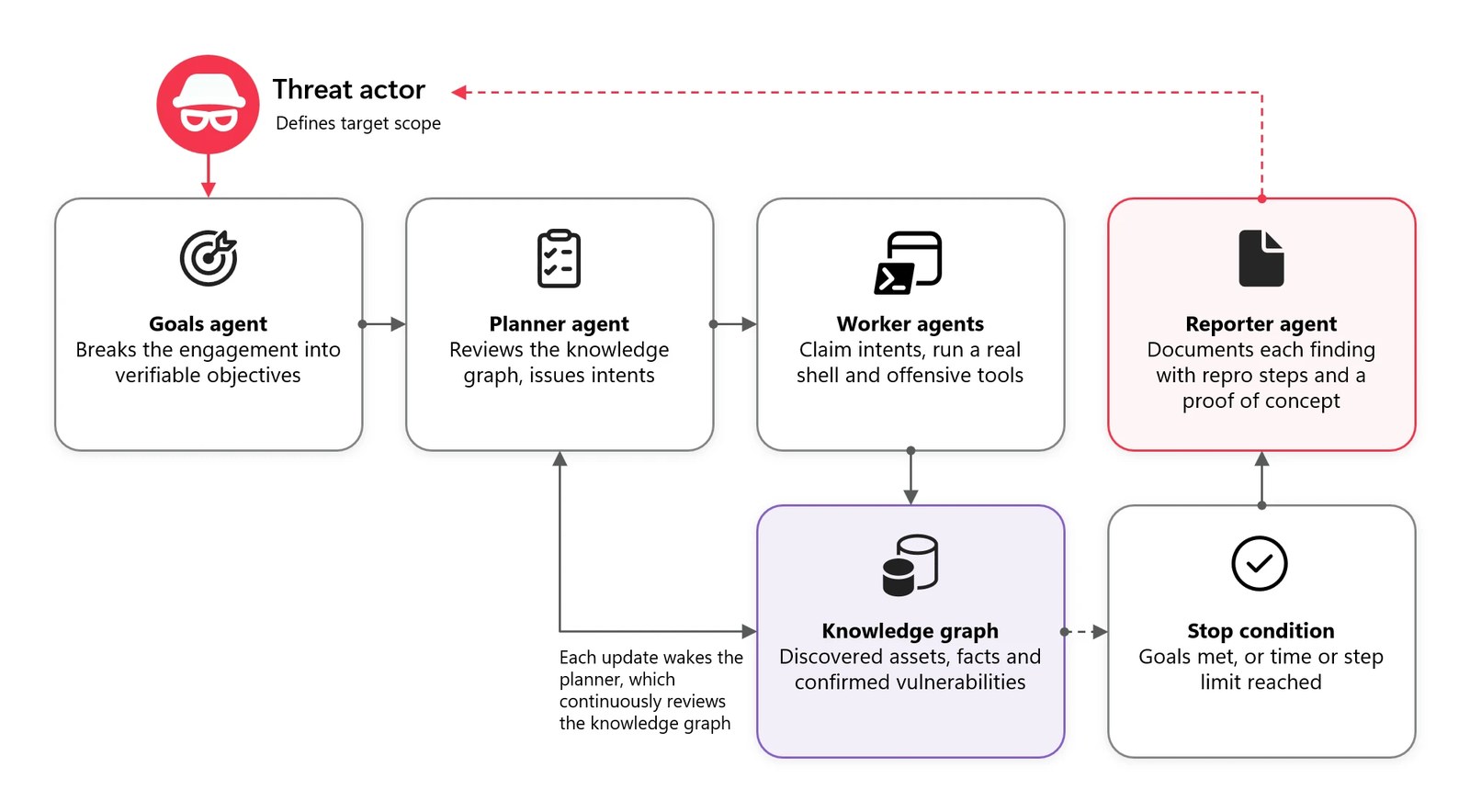
🧩 **How the tool works.** Microsoft describes the flow like this: attackers define scope and targets, then ARTEX uses AI agents that set verifiable goals, plan tactical steps for each stage, use tools against the targets, track discovered systems and results in graphs and report back to the attacker. A diagram in Microsoft's post shows a goals agent, a planner, several worker agents and a reporter agent. ARTEX has no language model of its own; it is connected to existing models.
🌐 **Who is behind it and how it spreads.** According to The Register, a GitHub user called "Autumn-27" published the source code with a Chinese-language interface in July; in November the Chinese security company ThreatBook claimed ownership of the tool. The original repository was taken down in October, but forks keep it available in several languages. The firm Infrawatch counts more than 130 variants, the paper reports, and calls ARTEX the most widely used agentic offensive framework at present.
🎯 **The best-known names.** Salt Typhoon is the group behind attacks on the US telecom companies AT&T and Verizon and on government systems. Crystal Typhoon, which Microsoft previously tracked as Storm-1849, is behind the ArcaneDoor campaign. Microsoft had already reported ARTEX use by Storm-0940 and Storm-3358: Storm-0940's compromise of ConnectWise enabled attempted sign-ins to more than 2,250 Microsoft 365 tenants, and Storm-3358 went after financial institutions. Other cases linked to ARTEX, according to The Register, include financial institutions in South Korea and India, the UK registrar 123 Reg and the European Commission. In recent weeks Microsoft has also reported campaigns in which ARTEX searched public repositories for exposed secrets and enabled supply chain compromise.
🔑 **Stolen access to AI models.** The FBI and AWS had already warned earlier this month. AWS described ARTEX being used to steal AI and cloud credentials "at industrial scale", giving attackers free access to advanced models.
📢 **Noisy, but fast.** The UK's NCSC, in a warning about such frameworks this week, listed their strengths: speed, thoroughness in probing systems, learning from failures instantly and low cost at scale. But the tools are noisy, it said, which makes them easier to spot in network logs and for defensive products. Microsoft's post gives detection guidance and recommends, among other things, regular red team exercises alongside vulnerability scanning. For organisations the lesson is plain: weakly protected systems, exposed keys and old holes that once took days to find can now be found in minutes.