🛡️ Google: attackers use AI to turn security patches into exploits with no human in the loop
In brief
- 🔬 Google's Threat Intelligence Group reported on November 16 the first observed framework ("exploit_agent") that turns patches into exploits and runs them with no human in the loop.
- 🌍 Targets per Google: French media, entertainment and education websites; no group or country is named.
- 🏛️ The FBI separately warned about the AI pentest tool Artex, with intrusions in some cases in under three hours.
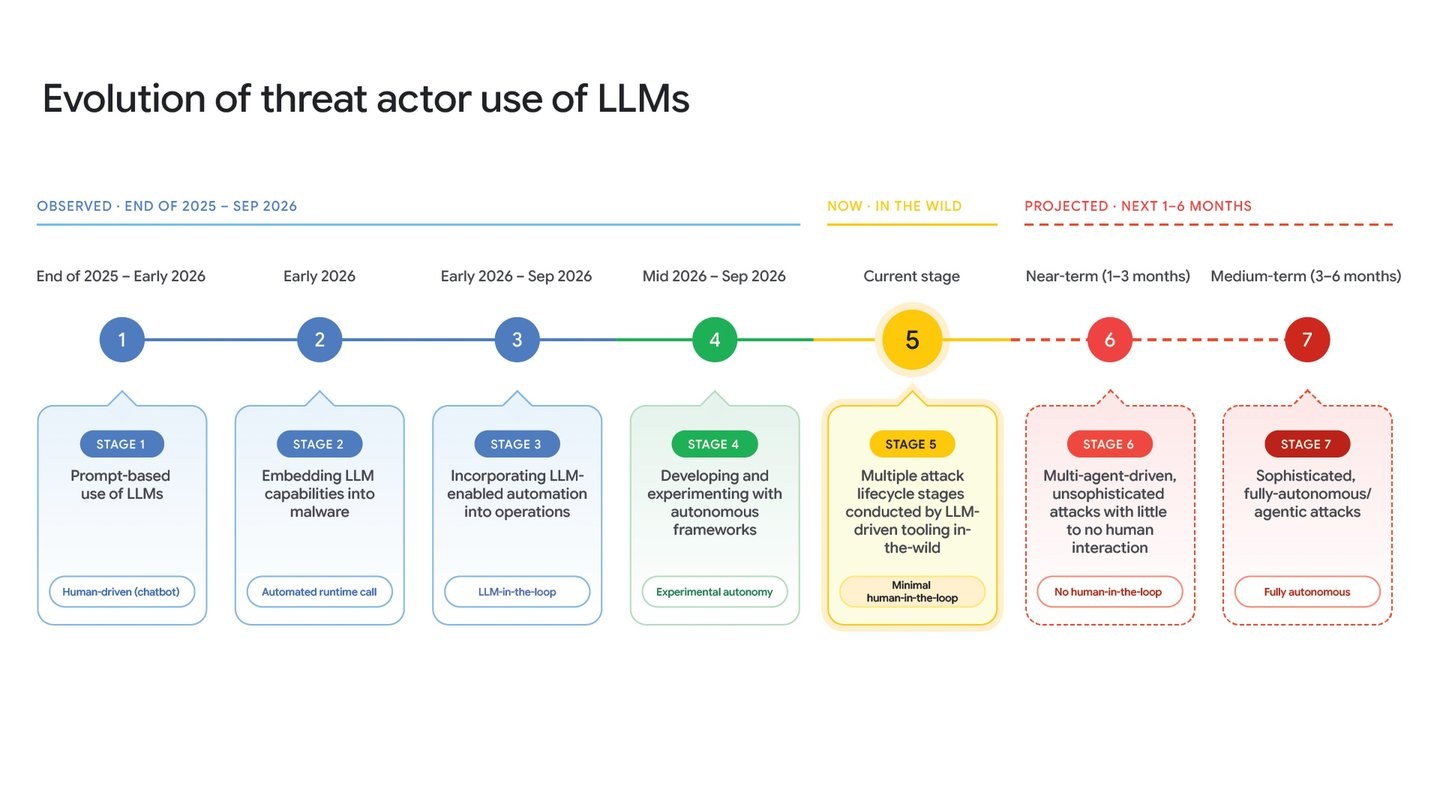
🤖 Google's Threat Intelligence Group (GTIG) described on November 16, 2026, in its AI Threat Tracker, the first case in which attackers fully automate vulnerability discovery and exploitation with AI. On an exposed staging server GTIG found a framework called "exploit_agent". It compares the code of popular web applications before and after each security update, spots the fixed flaw, drafts an exploit and runs it automatically. Server data suggests the operator targeted French media, entertainment and education websites. Google puts the activity at Level 5 on its own maturity scale and expects sophisticated, fully autonomous attacks within about six months. The same day the FBI warned about Artex, an open-source AI penetration-testing tool that took attackers from target selection to compromise in under three hours in some cases.
🗓️ The report describes how misuse of AI changed within a quarter. Two months earlier, GTIG said it had not yet seen fully autonomous attack pipelines in the wild. Now, according to SiliconANGLE and BleepingComputer, the group has observed attackers using LLM frameworks to discover and exploit vulnerabilities with no human in the loop for the first time.
🖥️ The find is an exposed staging server. It ran a multi-agent framework wired to several frontier and locally hosted language models. It continuously compares the code of popular web applications before and after each patch announcement. When it flags a likely flaw, it writes an exploit and runs it. The server also held stolen victim data, brute-forcing scripts, webshell installers and tools that remove webshells left by rival attackers. A Russian-language comment in its configuration file tells the operator to enter keys somewhere other than the chat. Google does not attribute the activity to a group or country.
🩹 GTIG suggests attackers may prefer n-day vulnerabilities, flaws that already have a public patch, over zero-days for systems like this, because published patches supply plenty of source material. Other examples in the report include two chained flaws in PaperCut print servers for which researchers produced working exploits with LLMs within a day, and a campaign four days after a disclosure that hit hundreds of organizations. Open pentesting frameworks are also in use: CAIRN against the US aerospace sector and a customized PentAGI against organizations in Asia. A suspected North Korean group, UNC6836, altered Claude Code settings files in internal repositories so that each launch downloaded a backdoor called SOMBERMEME.
📊 The assessment is sober. The Decoder reports that Google rates current activity at Level 5, where AI tools carry out several attack stages with minimal human involvement, and says more powerful attacks are only months away. BleepingComputer reports GTIG expects unsophisticated attacks needing little to no human interaction in about three months and sophisticated, fully autonomous ones in about six. For now these attacks trade stealth for speed and leave noisy forensic traces, which makes them easier to detect. Even so, the time defenders have to patch shrinks considerably, and the flood of AI-generated proof-of-concept exploits adds work to verify them. Google disabled accounts and assets tied to the Gemini misuse, and Google DeepMind used the findings to strengthen its classifiers.
📣 The same day, the FBI issued a flash advisory on Artex, according to TechCrunch. The platform went public in July; its developer later made it closed source, but the FBI says the earlier open-source version remains widely accessible. Attackers connect it to hosted models from Anthropic and OpenAI as well as open-source and non-US models. Artex scans networks, exploits simple weaknesses such as weak or exposed passwords and spreads to databases and mailboxes. The FBI calls the intrusions noisy, but fast enough that human defenders struggle to keep up; in some cases attackers went from targeting a system to active compromise in under three hours. Victims include financial services, government, technology, defense, telecom firms and law firms. In South Korea several financial institutions were hit, with at least 68,000 people's personal data stolen, largely because of weak defenses and missing multi-factor authentication. In the ConnectWise campaign, which Microsoft attributes to likely Chinese hackers, attackers reportedly reached the Microsoft 365 environments of at least 2,250 customers; ConnectWise says it cannot confirm that number. Google's report and the FBI advisory are separate documents that describe the same trend.
Sources
- Google warns that fully-automated AI attacks are coming soon (BleepingComputer)
- Google says an AI framework turned security patches into exploits with no human in the loop (SiliconANGLE)
- FBI says Artex AI open-source hacking tool used to breach networks in under three hours (TechCrunch)
- Google warns that fully automated cyberattacks have arrived and will get worse fast (The Decoder)