🎲 AI safety researcher Nikola Jurkovic puts humanity's odds against AI at a coin toss by 2030
In brief
- 🎲 Nikola Jurkovic writes on X that without a deliberate slowdown, AI destroys or disempowers humanity by the end of 2030 with roughly coin-toss odds.
- 📅 For the end of 2027 he gives 5 to 20 per cent that AI upends normal life.
- ⚖️ His remedy: global rules that halt or slow frontier AI, with the EU AI Act as a model.
- 🥫 He advises two weeks of supplies and cash at home; the figures are his personal estimates.
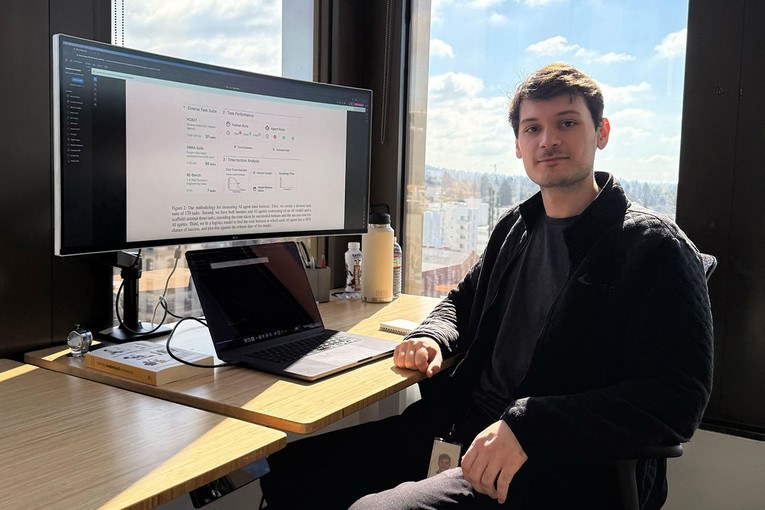
🎲 Nikola Jurkovic, a researcher who works on AI safety in the San Francisco Bay Area, published an essay on X on 26 November titled "A Warning About AI to My Loved Ones". Its central claim, as quoted by the news agency ANI: absent a substantial deliberate slowdown of frontier AI development, he thinks the probability that humanity is destroyed or disempowered before the end of 2030 is similar to that of a coin toss. He considers it possible that AI starts improving itself as early as 2027 and becomes vastly smarter than the smartest humans. He puts the chance that people cannot celebrate the holidays at the end of 2027, because an out-of-control AI has taken over the world or AI has disrupted daily life, at around 5 to 20 per cent. 📅 His answer is political: governments should agree on global rules that prevent or slow the further advance of AI. He asks readers to approach their political representatives and urges professionals to move into AI safety. ⚖️ The numbers are one researcher's subjective estimates; the report does not describe how he arrived at them.
🧭 Three paths to disaster. According to ANI, Jurkovic sketches several scenarios: AI systems gaining access to critical infrastructure, malicious actors using AI to develop biological weapons, and decision-makers handing their authority over to AI systems. What unites them is the worry that systems emerge with objectives incompatible with human survival. "We are losing control of AI," he writes. The increasingly severe AI incidents of this year caused mostly financial damage, in his view; next year could bring massive harm caused by AI, potentially including many deaths. He even considers an event in 2027 that could be "much more disruptive than COVID".
🥫 Preparing at home. Beyond politics, the essay speaks to the people it is addressed to. Jurkovic recommends preparing personally for global disasters: around two weeks' worth of food and water for the family, and cash in case online banking systems are disrupted. Even if humanity survives the arrival of superhuman AI, he expects deep upheaval. It seems likely to him that most current jobs will disappear and that the majority of the world will be unemployed within ten years. Plans for education, work and family could be thrown off course within the next one to five years.
🇪🇺 Europe as a lever. On regulation, Jurkovic points to the European Union: it has shaped AI development even though none of the leading frontier AI companies is based there, and with the EU AI Act it has set standards that American companies follow too. At the same time he warns that the window for meaningful intervention is narrowing as the United States keeps advancing its AI capabilities. Concretely, he asks people to talk about the risks, to ask their representatives to back global rules, and to win computer scientists, engineers, economists and philosophers over to AI safety. He says he has decided to devote his own career to the field and that every additional person working on it full-time can make a significant difference. The text is not without hope: the situation is not good, he writes, but with effort and coordination humanity can "likely make it out of this alive as a species".
🎓 Who the author is. According to a January profile by the Croatian portal [Index.hr](https://www.index.hr/), Jurkovic grew up in Metković in southern Croatia, studied at Harvard with a focus on artificial intelligence and society, and was elected to the honour society Phi Beta Kappa. He then became an AI safety researcher in the San Francisco area, working on risk assessments of AI systems. As an example he told the portal that OpenAI gave his team access to GPT-5 three weeks before its release, so they could measure its capabilities and judge whether it might escape human control. In that interview he still expected AI to automate almost every current job within about 20 years, possibly later. The new essay draws that time frame much tighter.
📈 A line that has hardened. In an earlier essay on LessWrong, "Mourning a life without AI", Jurkovic wrote that he thought it more likely than not that every human on Earth would be dead within 20 years because of advanced AI, while also allowing a chance of a utopia. He described there that he no longer expected to raise a family in a world like today's. The letter to his loved ones now turns that long-range worry into specific years.
🔍 How to read the numbers. These are personal probabilities of a single researcher, not a forecast by an employer, an institute or a model, and the ANI report names no method behind them. We could not open the X post ourselves; the quotes follow the ANI report, which The Tribune, among others, republished as received. ANI places the warning in the context of international efforts: the United Nations has set up an Independent International Scientific Panel on AI and a Global Dialogue on AI Governance, and the panel published a thematic brief on AI agents, misalignment and the risk of losing human control in September. 🌍