⏸️ Pause AI now or later? Daniel Kokotajlo and Ege Erdil argue over superintelligence before 2029
In brief
- 🎙️ On Dwarkesh Patel's podcast, Daniel Kokotajlo (AI 2027) and Ege Erdil (Google DeepMind) debate whether AI should be slowed down.
- 📊 Kokotajlo puts an intelligence explosion before 2029 above 50 percent, Erdil at about 20 percent; both say that alone calls for a plan.
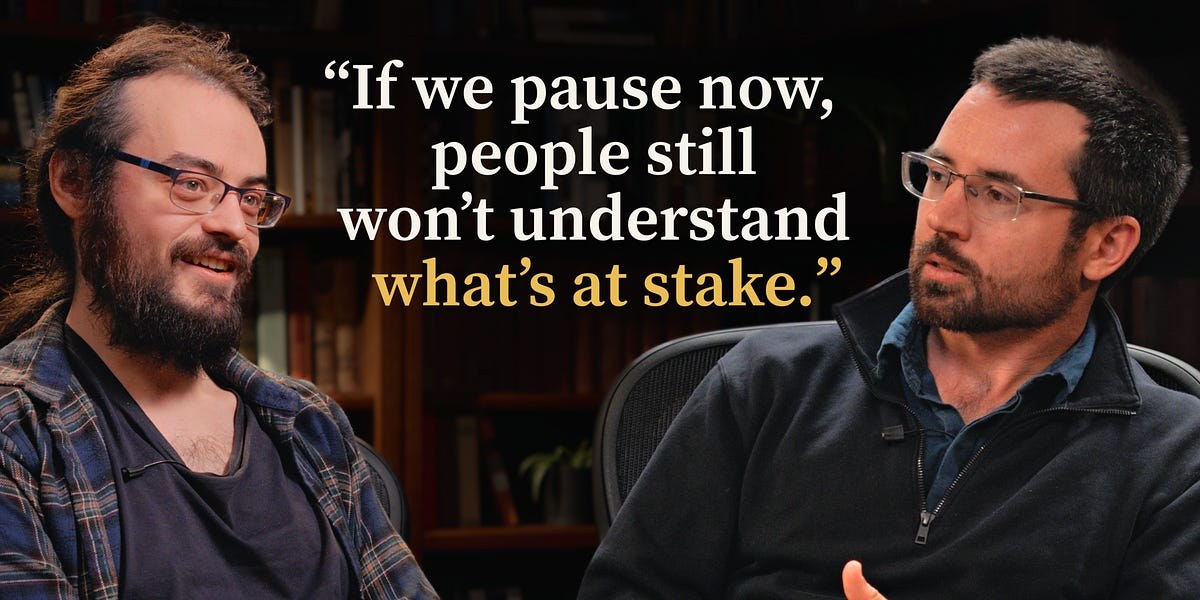
- ⏸️ Erdil calls a pause now premature: the public does not yet grasp what is at stake.
- 🌏 Both expect that a deal with China will be needed in the end.
🎙️ In a new episode of [Dwarkesh Patel's podcast](https://www.dwarkesh.com/p/daniel-kokotajlo-ege-erdil), two researchers with very different reputations meet: Daniel Kokotajlo, co-author of the AI 2027 and AI 2040 scenarios at the AI Futures Project, and Ege Erdil, introduced on the show as a researcher at Google DeepMind. Patel expected a debate; by his own account the two agreed on more than he thought they would. 📊 The main dispute is timing. Kokotajlo thinks it is more likely than not that AI companies fully automate AI research in 2027, and says that unless the companies are substantially slowed down, we will probably lose control. Erdil gives such an explosion within the next three years only 10 to 20 percent. He stresses that this is no difference in kind: even a 20 percent chance of a very bad outcome calls for action. ⏸️ On a pause, they part ways. Erdil thinks stopping now is premature: without visible capabilities the public will not understand what is at stake, and a pause would be carried by groups opposed to AI for quite different reasons. Kokotajlo replies that every year gained brings progress in safety research and more awareness in politics and society. 🌏 Both agree that a deal with China will probably be needed in the end. Erdil calls the current US confrontation with China short-sighted and dangerous because it undermines any coordination. Everything in the episode is the speakers' assessment and forecast, not established fact.
🧮 **Why Erdil doubts the fast explosion.** At the core of his scepticism is the so-called software-only singularity: the idea that better AI, with fixed compute and fixed data, keeps building better AI ever faster. His argument is the cost of verification. A maths proof can be checked on an ordinary computer; whether a change to training really saves compute often only shows in large, expensive runs, and small experiments give false positives and false negatives. That is why he does not expect AI research to see the same leap as mathematics. Without self-improvement, his median for the full automation of all work is 15 to 20 years; Patel sums it up as a median around 2040.
⏳ **What one more year is supposed to buy.** Kokotajlo points to a proposal from the AI Futures Project that, by his estimate, would push the expected intelligence explosion back by about a year, from 2027 to roughly 2028. One model discussed in the episode: AI companies would be allowed to spend only 5 or 10 percent of their compute on AI research. Kokotajlo says US companies would then still have about as much compute for it as Chinese ones, so this level would not even need a deal. Erdil counters that China's lag in manufacturing technology such as EUV lithography machines is only temporary and buys perhaps five years.
🤖 **Does misaligned AI slow itself down?** Erdil expects bad behaviour by the systems to slow companies down from the inside: a swarm of AI agents that fabricates results, runs experiments sloppily or lies to each other makes fast research hard. Kokotajlo compares this with science and industry in the Soviet Union: plenty of friction, but no standstill. In his view such AI would progress more slowly than it could, but none of it would look like a pause.
👪 **Descendants or invaders?** Erdil sees future AI more like a new, more capable generation to which humanity hands over control, as every generation does to its descendants. Kokotajlo thinks the gap in values between a superintelligence and us will be far larger than between parents and children and worries above all about the imbalance of power; he recalls conquests in which a superior power arrived on foreign shores. Erdil puts the chance that AI cares enough about humans for the future to go well for them at about 65 percent. He bases this on today's models mostly doing harmless things when given a free hand. Combined with Erdil's 20 percent for a fast breakthrough, Patel works out roughly 6 percent for a bad outcome.
🧪 **How honest are the models?** Kokotajlo argues that shallow values given to models through prompts and fine-tuning get wiped away in reinforcement learning as soon as they clash with the reward; hence sycophancy, cheating and reward hacking. Erdil partly disagrees: sycophancy and made-up facts have declined despite more training, and only reward hacking has got worse. Kokotajlo agrees on sycophancy but credits better training environments rather than real honesty.
🔮 **Forecasts for 2027.** Kokotajlo says 2027 will unfortunately probably look like his AI 2027 scenario, and that he is trying to bring about a slowdown. Looking back, he concedes that the scenario predicted China's state stepping into AI development in summer 2026, which did not happen that way; it did get the rise of coding agents right. Erdil expects, by the end of 2027, robots that do simple tasks such as folding laundry at roughly human speed, and AI that can play through an arbitrary game from the Steam catalogue without having been trained on it. He puts the annual revenue of the largest AI company at that point at 250 to 300 billion dollars.
🗳️ **The shared core.** Both complain that there is no plan. Erdil speaks of denial: many people, including in financial markets, do not take the technology seriously, and decisions such as whether AI labs must disclose more are made without open public deliberation. He compares it with wars that states drifted into without a clear decision on costs and benefits.