📊 ECB survey: 44% of euro-area workers use AI weekly on the job, 18% daily
In brief
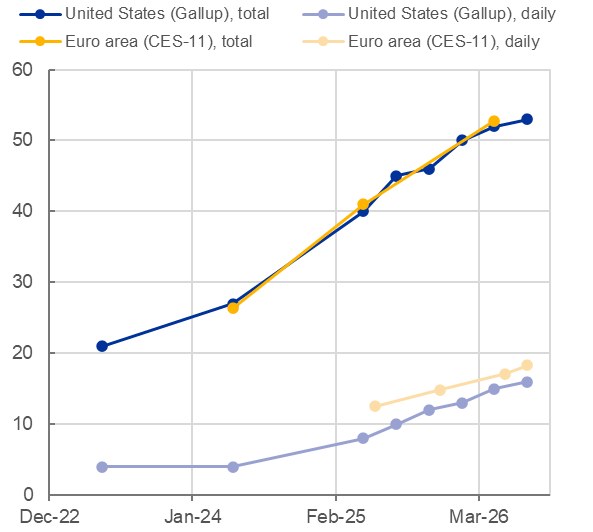
- 📊 In August 2026, 44% of employed euro-area consumers used AI at work at least weekly and about 18% daily.
- 🌍 Adoption is roughly on par with the US, the ECB says; daily use is even higher in the euro area, though the gap is narrowing.
- 💼 56% of users say they get more work done with AI, 47% say their output is of higher quality.
- ⚠️ Main barriers: skills gaps plus privacy and security concerns; investment lags far behind the US.
📊 Artificial intelligence has become part of everyday work in the euro area. According to the European Central Bank's Consumer Expectations Survey, 44 percent of employed respondents used AI at work at least once a week in August 2026, and around 18 percent used it every day. In May, more than half had already said they use AI at work at all. The economists Dimitris Georgarakos, Geoff Kenny and Justus Meyer present the figures in an ECB blog post dated 27 November. 🌍 In the authors' assessment, overall adoption in the euro area is thus similar to that in the United States. Strikingly, a larger share of euro-area consumers uses AI daily, although that lead is shrinking. Investment tells a different story: an estimate the ECB cites expects business investment to rise by around 40 percent in the US between 2021 and the end of 2027, against about 12 percent in the euro area. That could deepen Europe's dependence on foreign AI technology and infrastructure. 💼 Many users report concrete benefits, though not all. Respondents also expect AI to spread further, yet they see a higher risk to their jobs rather than higher income, and a sizeable share expects AI to push up prices.
🧾 What users report. Around 56 percent of workplace AI users say the technology lets them complete more work, and 47 percent say they produce higher-quality output. Among those who get more done, 62 percent credit AI's help in finding or processing information and 51 percent say it reduces the effort their work takes. Other benefits named include generating new ideas, automating repetitive tasks and handling larger workloads. These are respondents' own perceptions, not measured productivity.
🔍 Why the gains are not universal. Users who see no increase in output most often point to the time needed to check or correct AI-generated results. Other obstacles are tasks AI is not suited for and concerns about retaining control. The authors conclude that productivity gains depend on what AI is used for and how much verification and human oversight remain necessary. Time savings alone do not raise productivity, they argue: workers must turn faster task completion into more or better output, and firms must invest in skills, data, computing capacity and organisational change. They expect a gradual process of experimentation and adjustment.
🧱 The barriers. Skills and knowledge gaps, together with privacy and security concerns, are among the obstacles cited most often, and they look similar across the largest euro-area economies. Social norms and existing regulation are named less often as direct barriers. The authors read this as an argument for euro-area-wide measures: training, clear employer policies on safe AI use and better access to approved tools. Trusted, well-governed tools, such as European solutions, could encourage wider use.
📈 Expectations for the coming years. In August 2026, employed respondents aged 18 to 64 expected 46 percent of workers in their sector to use AI within five years, up from 34 percent a year earlier, and the upward revision shows across the whole distribution, not only among optimists. About half of respondents expect AI to save time on everyday tasks or to make it easier to find the best prices. At the same time many anticipate costs, such as learning new skills and spending more time checking information. Over the next year, they consider a higher risk of job loss more likely than higher household income or better job opportunities.
💶 Why a central bank cares. According to the authors, AI affects the economy through two channels: the productivity gains it eventually delivers and the expectations it creates along the way. Both shape spending, saving, investment, labour-market choices and, in the end, prices. Respondents who expect AI to raise prices mostly cite greater pricing power for firms and higher energy and material costs.
⚖️ Regulation. Demand for AI rules is not simply a matter of unfamiliarity: it is as strong among regular AI users as among people who use it rarely or never. Support for regulation also tends to be higher in countries where workers see a greater risk of losing their jobs to AI, although the authors stress that this does not establish causality. Europe's challenge, they write, is to put safeguards in place without unnecessarily slowing the investment needed to realise AI's potential.
📚 About the source. The post draws on the work of an ECB research task force on the economic effects of AI; a fuller working paper on AI diffusion in the euro area is announced. Ipsos carries out the survey for the ECB. As usual for the blog, the views are the authors' and not necessarily the ECB's. Bloomberg was first to report the figures in detail.