🎓 Does AI make students lazier or sharper? It depends on who does the thinking
In brief
- 📚 94% of UK undergraduates in a HEPI survey use generative AI for assessed work
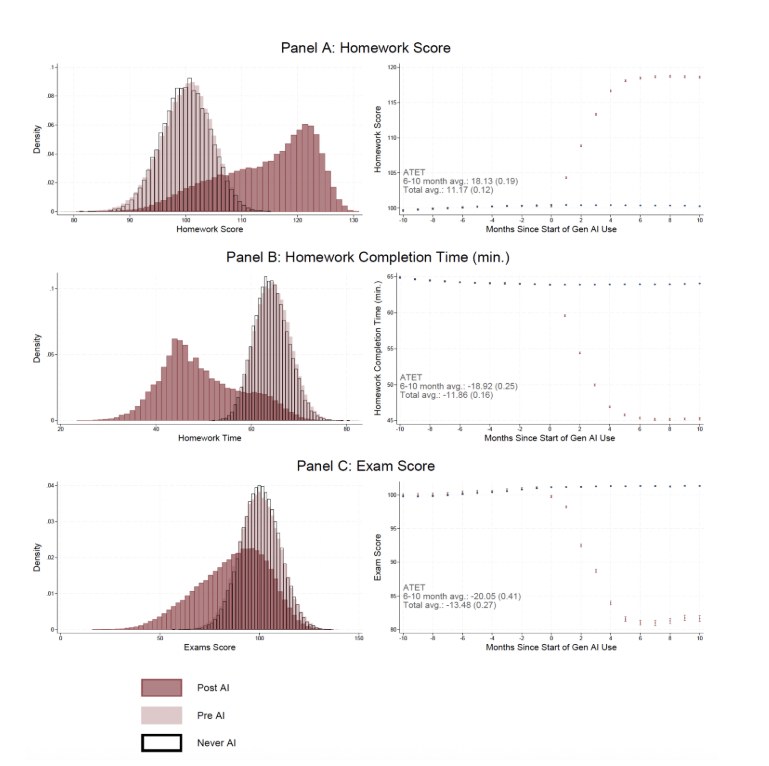
- 📉 China study: better homework, but monthly exam scores down 20% after six months
- 🧪 A purpose-built AI tutor at Harvard more than doubled learning gains
- 🧠 Expert Rose Luckin advises: think first, then use AI to challenge your answer
🎓 Does AI make learners lazy or sharp? London's *Standard* looked at studies and spoke to experts. The answer depends on how the tools are used: Rose Luckin, professor emerita at UCL, says AI makes people lazier when it does the thinking for them and sharper when it makes them explain their thinking. 📉 Research from China supports the worry: with AI, homework got faster and better, while results in exams without AI fell. 🧪 A Harvard trial shows the other side: with a carefully designed AI tutor, students learned more in less time. 💼 The report also links the question to starting a career, which one researcher says is getting harder in London.
📚 **How widespread it is.** *Standard* writer Lucas Chancellor cites several surveys: for Safer Internet Day 2026, 97% of children aged eight to 17 in a poll of more than 2,000 UK children reported using AI tools. According to Teacher Tapp, 58% of secondary teachers reported a pupil using AI without permission in 2026, up from 15% in 2023. The [HEPI and Kortext survey](https://www.hepi.ac.uk/reports/student-generative-ai-survey-2026/) of 1,054 full-time undergraduates, fielded in December 2025, also found that 12% put AI-generated text straight into assessed work, against 3% in 2024. Almost half say AI has improved their student experience.
🔍 **The China data in detail.** For their working paper, David Strömberg, Victor Lei and Yanhui Wu analysed 30 months of records on 26,811 pupils in grades 7 to 12 in a county in central China. In their [VoxDev column](https://voxdev.org/topic/education/generative-ai-learning-penalty-secondary-school) they report that time per homework assignment fell from 64 to about 45 minutes while homework scores rose 18%. For the high-stakes entrance exams the loss built up over roughly two years, reaching 24% for high-school entry and 18% for college entry. About four in five AI users finished unusually fast, a pattern consistent with outsourcing the work. Those who spent as much time as non-users scored similarly in exams. The authors caution that the groups may also differ in motivation and AI skills, so simply requiring more homework time would not necessarily fix it.
🧪 **The Harvard trial.** The randomised study [published in Scientific Reports in 2025](https://pmc.ncbi.nlm.nih.gov/articles/PMC12179260/), with 194 students in a physics course, compared a custom tutor with in-class active learning. The tutor followed the same teaching principles as the lessons; according to the *Standard*, it gave one step at a time. The result therefore does not simply carry over to freely used chatbots.
✏️ **What experts suggest.** Luckin sees the problem less in students than in what they are asked to do: assignments need to be designed so that AI cannot just complete them. She warns the tools might make you feel cleverer than you really are. Her advice to students is to work out their own answer first. Daniel Susskind, author of *What Should My Children Do?*, suggests parents teach and test both, working with AI and without it, with reading, writing, maths and independent thinking as the basics.
💼 **Getting into work.** Prompting and checking AI well takes experience that is often gained in entry-level jobs. According to the report, online job adverts in London were 64% below their May 2022 peak in February 2026, and early this year nearly one in four economically active 16 to 24-year-olds in the city was out of work. Daniel Reast of Centre for London says it is too early to put a credible percentage on AI's contribution, with hiring costs and a weak economy the bigger cause. But he calls AI an additional and potentially structural pressure. Employers, he argues, should replace the training value of vanishing routine tasks with supervised projects, mentoring and clear routes to progress. Their real-terms training investment in London fell by more than 45% between 2011 and 2024.
Sources
- Student Generative Artificial Intelligence Survey 2026 (HEPI)
- AI tutoring outperforms in-class active learning (Scientific Reports (PMC))
- It's AI, stupid: is artificial intelligence making kids lazier or smarter? (The Standard)
- Better homework, worse exams: How AI use hurts student learning (VoxDev)