🐕 Italy's state motorway company sends an AI robot dog to guard its worksites
In brief
- 🐕 Autostrade dello Stato unveiled a four-legged AI robot in Verona to monitor motorway construction sites.
- 🌙 It is meant to patrol on its own, also at night, map the site in 3D and detect intruders and hazards.
- 🦺 Its AI also checks whether workers wear their protective equipment.
- 🚇 The first test is on the Fréjus Tunnel network; the tender for the robot was valued at €250,000 over 24 months.
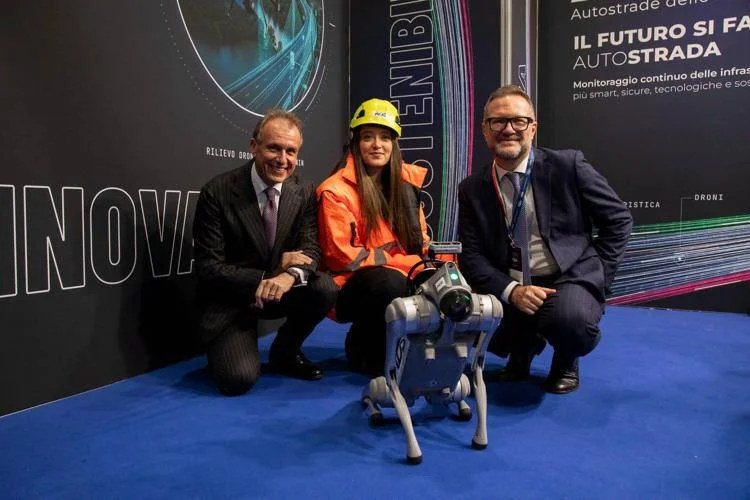
Autostrade dello Stato, Italy's state motorway company, presented a robot dog for construction-site safety on 26 November. It was shown at the national assembly of the municipalities' association ANCI at the Veronafiere exhibition centre. 🐕 The quadruped carries sensors, panoramic and thermal cameras, ambient microphones and acoustic detectors. It is designed to patrol work areas autonomously, also at night, build a three-dimensional map of them, flag unauthorised access and spot potential hazards. 🦺 Using AI, it is also meant to track progress on the site, report possible clashes between operations and check that workers wear their personal protective equipment correctly. The first trial site is the Fréjus Tunnel network between Italy and France. The company describes a shift from reactive to predictive maintenance; AI does not replace people, says chief executive Vito Cozzoli.
📑 **A proof of concept with a budget.** According to the company, the robot dog is the latest of several proofs of concept in an innovation programme for infrastructure safety and monitoring. The news agency AGI reports that the project was preceded in September by a European tender for a quadruped robot and accessories, intended for an integrated system to monitor and manage worksites. The estimated contract value was €250,000 for a term of 24 months. Neither AGI nor Adnkronos names the maker of the robot.
🚇 **Fréjus trial: done or still to come?** The two reports differ on one detail. Adnkronos writes that the robot "will be" tested for the first time on the Fréjus Tunnel network; AGI says it was tested there for the first time. Both agree on the place, not on the timing. The Fréjus road tunnel links Piedmont with Savoy and is one of the main Alpine crossings for freight traffic.
🛰️ **Part of a wider programme.** According to both reports, the same programme includes drones, digital twins of the structures and smart cameras in tunnels meant to improve emergency handling after crashes and fires. Chairman Carlo Vaghi said the aim is to put technology at the service of the safety of workers and road users, to know the structures better, prevent risks and run worksites better.
🦺 **Why worksites?** Cozzoli argues that infrastructure safety starts with the safety of the people who build, operate and maintain it. With the robot and the other tools, he said, the company is moving to an approach based on continuous monitoring and spotting risk signals early. An AI that checks protective equipment is likely to raise questions about worker surveillance as well; neither the company nor the two reports addressed that.
🤖 **Context.** Quadruped robots have been tested on construction sites worldwide for several years, mostly for inspections and progress checks. What is new here is a state motorway operator trying to combine patrols, access control and occupational safety in one machine. Whether the trial turns into regular operation is open: the company itself calls it a proof of concept.