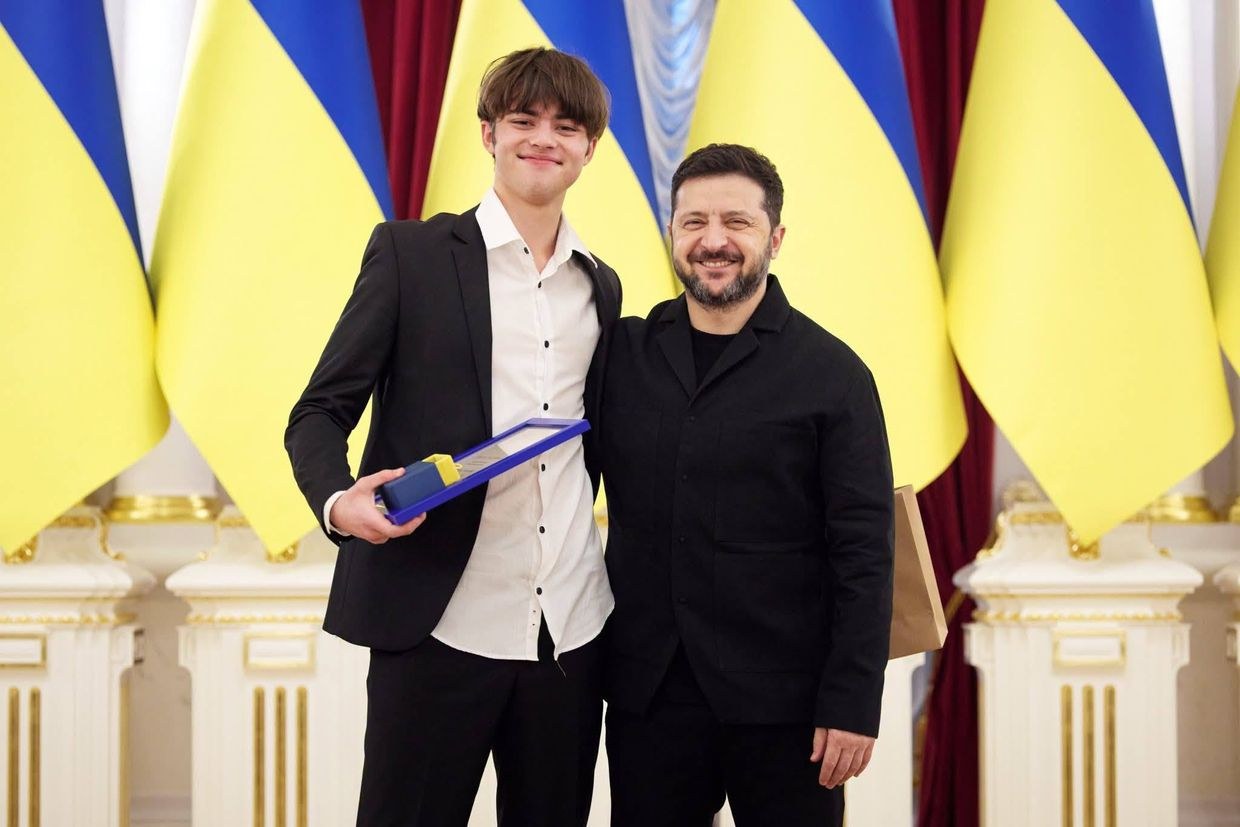
🛰️ Poltava student builds AI drone autopilot and receives Ukraine's 'Future of Ukraine' award
In brief
- 🏅 Yaroslav Sheiko, an 11th-grader at Lyceum No. 33 in Poltava, has received the state distinction 'Future of Ukraine'.
- 🛰️ He develops AI-based autopilot and optical-electronic stabilisation systems for drones.
- 📡 According to Tom's Hardware, the autopilot is meant to guide drones to their target without GPS, which matters under Russian jamming.
- ❓ How the systems work technically has not been published.
🛰️ A secondary school student is among the young Ukrainians honoured this year with the state distinction 'Future of Ukraine'. Yaroslav Sheiko is in the 11th grade of Lyceum No. 33 in Poltava. The city of Poltava lists as his main work new AI-based systems for drone autopilot and for optical-electronic stabilisation. According to the regional administration, the President presented the award on the occasion of Children's Protection Day, which Ukraine marks on 20 November. 📡 The US tech site Tom's Hardware reports that the autopilot is designed to bring uncrewed aircraft to their destination without relying on GPS signals. That is exactly what the front needs, because Russian electronic warfare frequently disrupts satellite navigation. Nobody has yet published how Sheiko's systems work or whether they are in use.
🏅 **The record behind the award.** According to the city administration, Sheiko has twice held a scholarship of the President of Ukraine and has twice won the national final of the research competition of the Junior Academy of Sciences (MAN), in the section for aerospace and defence technologies. MAN is the state network in which school students carry out supervised research projects and defend them before juries. Internationally he won a gold medal at the INOVA 2025 invention show and silver at a 2025 hackathon.
🎓 **More than engineering.** The head of the Poltava regional military administration, Vitaliy Diakivnych, describes him as one of the most active members of MAN's Poltava branch. Besides his research, he says, Sheiko volunteers, takes part in public life and helps peers who are just starting out in science. That fits the purpose of the distinction: when the President gave it to a first larger group of 20 pupils and students in November 2025, the decree named courage, resilience, civic engagement and volunteering alongside achievement.
📡 **Why navigating without GPS matters.** Drones usually find their way by satellite signals. On the front both sides jam those signals heavily, so aircraft drift off course or crash. Systems that orient themselves with cameras and image analysis instead are therefore among the most sought-after developments of the drone war. Tom's Hardware places Sheiko's work in a line of Ukrainian homegrown solutions: Ukraine has, for example, fitted its US-supplied Puma reconnaissance drones with domestic anti-jamming systems and uses a network of flying radio relays to extend the range of its attack drones without depending on Starlink.
❓ **What remains open.** Neither the city nor the regional administration has given technical details: which sensors the autopilot uses, how exactly it navigates without GPS, whether it has been tested or handed to military units. Tom's Hardware also notes that Ukraine has not explained how the inventions work. For weapons technology in an ongoing war that is not unusual. What is documented so far is the award itself and the list of competition results published by the city of Poltava.
🌍 **The wider frame.** Russia's attack on Ukraine began in 2014, the full-scale war in 2022. Drones and the defence against them have become the central field of arms development in that time, and Ukraine relies heavily on its own engineers, including very young ones. Sheiko's path through the Junior Academy of Sciences shows how early that support starts.
Sources
- Учень полтавського ліцею № 33 Ярослав Шейко отримав від Президента державну відзнаку «Майбутнє України» (Nova Poltavshchyna)
- Полтавець Ярослав Шейко отримав президентську відзнаку (Poltava Wave)
- Ukrainian 11th-grader builds AI-powered, GPS-free drone autopilot to beat frontline jamming (Tom's Hardware)
- Zelensky awarded pupils and students with 'Future of Ukraine' distinction (Ukrinform)