🔐 Snap's gateway also checks the rights of the human behind an AI agent
In brief
- 🚪 A central MCP gateway connects employees and AI agents to internal tools
- 👥 For restricted tools, both the person and the agent must have access
- 📊 More than 60 MCP servers, over 1,100 tools, about 1.6 million calls in one week
- 🪪 An attestation token records who started each call
- ⚠️ Snap says prompt injection is not fully solved
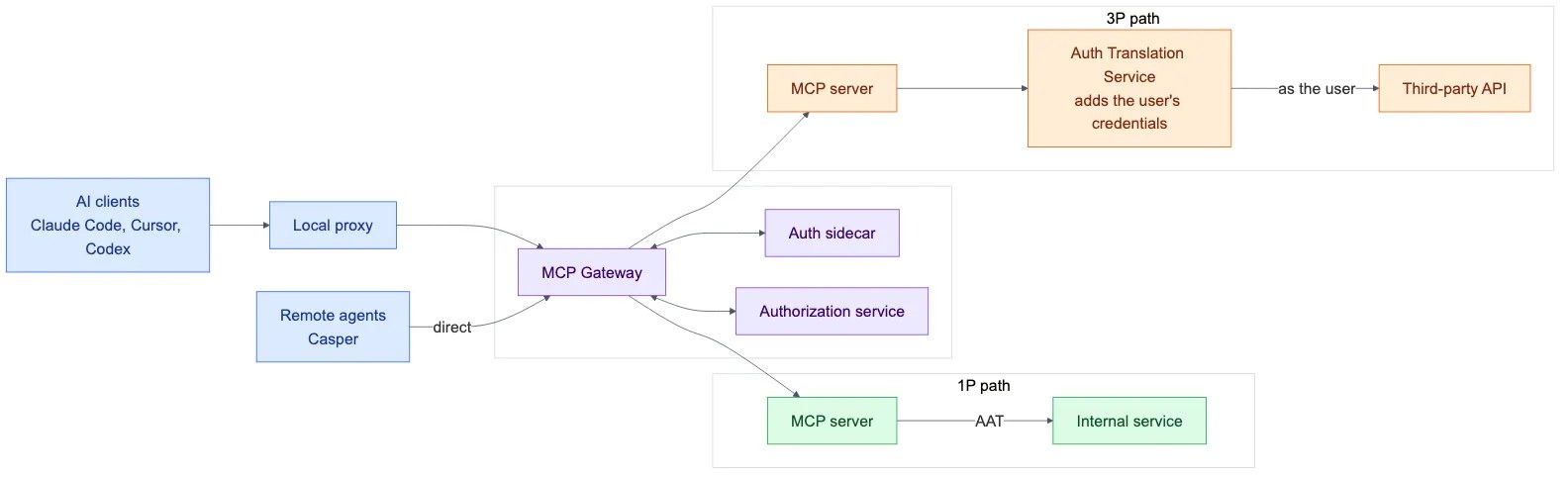
🔐 When an AI agent does something for a person inside Snap's systems, a call to a restricted tool must be allowed for both of them. The company describes this in an engineering post about its MCP gateway, the shared path to tools built on the Model Context Protocol (MCP), which agents use to reach services. 📊 According to Snap, it fronts more than 60 MCP servers with over 1,100 tools. In the week ending October 11, 2026, people and the in-house agent system Casper made about 1.6 million tool calls through it, with automated service accounts adding several million more per week. 🛡️ The underlying problem concerns many companies: internal systems mostly assume a human at a browser. Once an agent acts, identity easily gets lost along the way, and it is no longer clear who caused an action.
🧩 The trouble showed up early. One MCP server Snap tested worked locally but was refused as forbidden behind a central gateway, because the receiving service saw only the server's service account. In another test, a pull request that an agent opened for an engineer appeared to come from the agent's GitHub app.
🏗️ The first setup was a local go-between called MCP Proxy. Many servers had to run as Docker containers on people's machines, and OAuth logins for services such as Jira and Slack expired about daily. Beyond ten or so servers this became painful. Snap became a design partner of Docker, which built the gateway core, and integrated it with its internal service mesh.
🪪 Each agent has its own machine identity and starts with read-only default permissions. The Agent Attestation Token, built by the developer productivity group with Snap Security, names the original requester and the agent making the call. Only a few trusted services such as [Casper](https://eng.snap.com/casper) can obtain tokens naming someone else as requester, and they verify that person first, for Slack requests by checking the message signature. The rule works both ways: a person outside the right team is denied even if the agent is allowed the tool, and an agent does not get everything its person can do.
✍️ Write access is earned tool by tool. Each tool is classed as read or write, destructive ones are flagged, and unclassified ones cannot be granted. An agent owner who wants more files a pull request that listed approvers must accept; destructive tools need both the agent's team and the tool owner. One on-call agent got exactly six read-only tools for a weekly report. Since the first grant in August 2026, more than 60 agents have received tools beyond the defaults.
🔑 Third-party credentials sit neither in the gateway nor in the MCP servers but in a token service owned by Security, and agents never receive the keys. Calls, authorizations and denials are recorded for auditing. Reads count as sensitive too, because text from one tool can steer what an agent does with the next.
🔭 Snap now plans to make the gateway the default. It is considering human confirmation before riskier actions and checks on whether a combination of permissions is too risky. Its advice to others: build identity early, let teams build their own servers, and load tools on demand, since every tool description uses up model context.