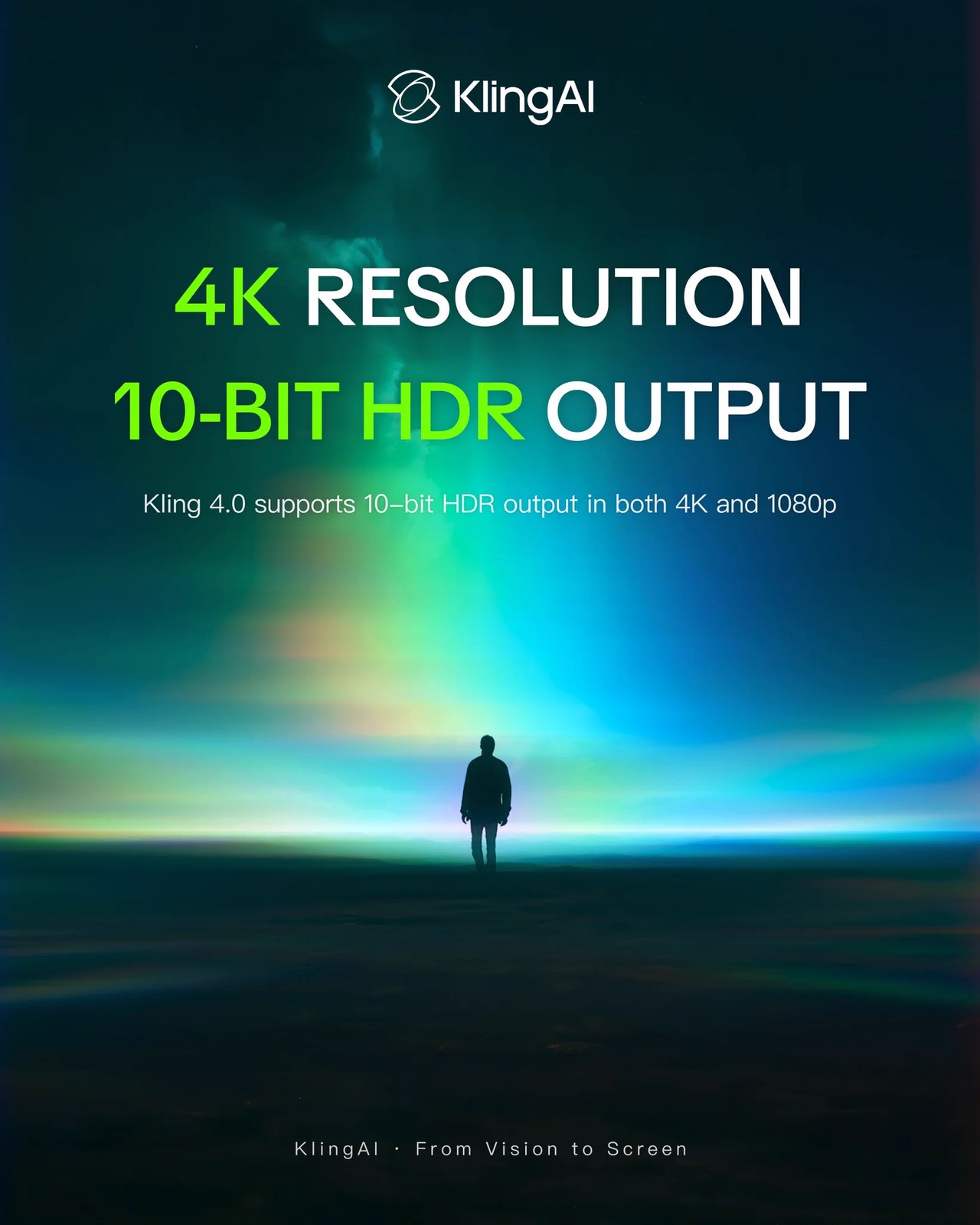
🎬 Kling 4.0 now renders 10-bit HDR video in 4K and 1080p
In brief
- 🎬 Kuaishou's AI video model Kling 4.0 now outputs video in 10-bit HDR, in native 4K and in 1080p.
- 🌃 According to Kling, backlit, night and neon scenes keep more detail in highlights and shadows, with less colour banding.
- 🎨 It mainly helps people who grade footage afterwards or deliver for HDR screens.
- ❓ The announcement names neither the HDR standard, the codec nor a price for HDR output.
🎬 The Chinese company Kuaishou has switched on a feature of its video model [Kling 4.0](https://kling.ai) that was still marked "coming soon" when the model was introduced in September: videos can now be rendered with 10-bit colour depth in HDR, both in native 4K and in 1080p. Kling announced the change on X on 19 November; on 27 November it followed with a post that uses creators' clips to show what the HDR output looks like. 🌃 According to Kling, the 10-bit output gives finer colour gradation and smoother transitions between light and shadow. In high-contrast scenes such as backlight, night or neon lighting, more detail is meant to survive in bright and dark areas, and colour banding should appear less often. Kling 3.0 only produced 8-bit SDR. 🎨 This is mainly of interest to people who process AI clips further: for advertising, film or music videos, where footage is colour graded afterwards and delivered for HDR screens. Anyone who only makes short clips for social networks will need the difference less. Still open: which HDR standard and file format Kling uses, and what HDR renders cost.
🧭 **Where the model stands.** Kuaishou introduced Kling 4.0 on 28 September and at first released only a faster variant, Kling 4.0 Flash, to a small group of yearly subscribers; the full model was due in October. Even in that announcement two items sat under "coming soon": native 4K output and 10-bit HDR at 4K and 1080p. With its post of 19 November, Kling declared both available. VP Land, a trade site covering film and video production, read this on 20 November as AI shots now coming out of the model at delivery resolution and with more colour depth, without an upscaling pass in between.
🔬 **What 10 bits mean in practice.** An 8-bit video has 256 brightness steps per colour channel, a 10-bit video 1,024. The difference shows where smooth gradients occur, such as an evening sky or a lit wall: with few steps, visible bands appear. For post-production the headroom matters too: push exposure or colours hard and 8-bit material breaks up sooner. Kling itself justifies the feature in exactly these terms and speaks of more flexibility in colour grading. Whether that holds up is something colourists will have to test on their own shots, VP Land notes.
📐 **What else Kling 4.0 does.** According to Kling's own blog, the model generates clips of 3 to 30 seconds in one pass, with up to 10 keyframes that fix poses, scene changes and turning points at set points on the timeline. One generation can combine up to 15 references: up to 10 images, up to 5 videos with at most 30 seconds in total, and up to 7 characters or objects, optionally with a set voice. On top come stereo sound with more accurate lip sync, the 21:9 widescreen format, prompts of up to 8,000 tokens and targeted changes to existing footage, such as facial expression, camera angle or background. The maker says speech and on-screen text work in German, English, Chinese, Japanese, Korean, Spanish, Portuguese, French and Hindi, among others.
🖥️ **How to get it.** Kling is a web application with an account at kling.ai; the creation page was rebuilt with version 4.0 and gathers text, images, videos and audio references in one input box, along with a timeline, a canvas and an agent that takes tasks in plain words. Which subscription tier unlocks 4K and HDR is not stated in the announcement.
⚠️ **What remains open.** VP Land points to gaps that matter for post-production: Kling names neither the HDR transfer function (such as PQ or HLG) nor the codec and container of the files, and the announcement lists neither credit prices nor length limits for 4K and HDR renders. Anyone who wants to put the footage into a professional pipeline should settle these points on a test clip first. For those who publish only in SDR anyway, the feature changes little; for teams delivering for HDR televisions, cinema or streaming, it can save a detour through upscaling and colour conversion. 🎞️
Sources
- Inside Kling 4.0: A Complete Guide to AI Video Creation (Kling AI)
- Introducing Kling 4.0 (Kling AI)
- Kling 4.0 vs 3.0: Key Differences Explained (Kling AI)
- Kling AI: Kling 4.0 now supports native 4K and 10-bit HDR (Kling AI on X)
- Kling AI: Kling 4.0 with 10-bit HDR output in 4K and 1080p (creator showcase) (Kling AI on X)
- Kling 4.0 Adds Native 4K and 10-Bit HDR Output (VP Land)