🧱 ToyBlocks: A tabletop world makes robot failures easier to diagnose
In brief
- 🔤 Ai2 releases an open simulation in which a robot searches for, turns and stacks lettered blocks.
- 🔢 Tasks and demonstrations are generated automatically. The initial dataset contains 85,336 longer sequences.
- 🔍 Researchers can separate failures of planning, perception and movement.
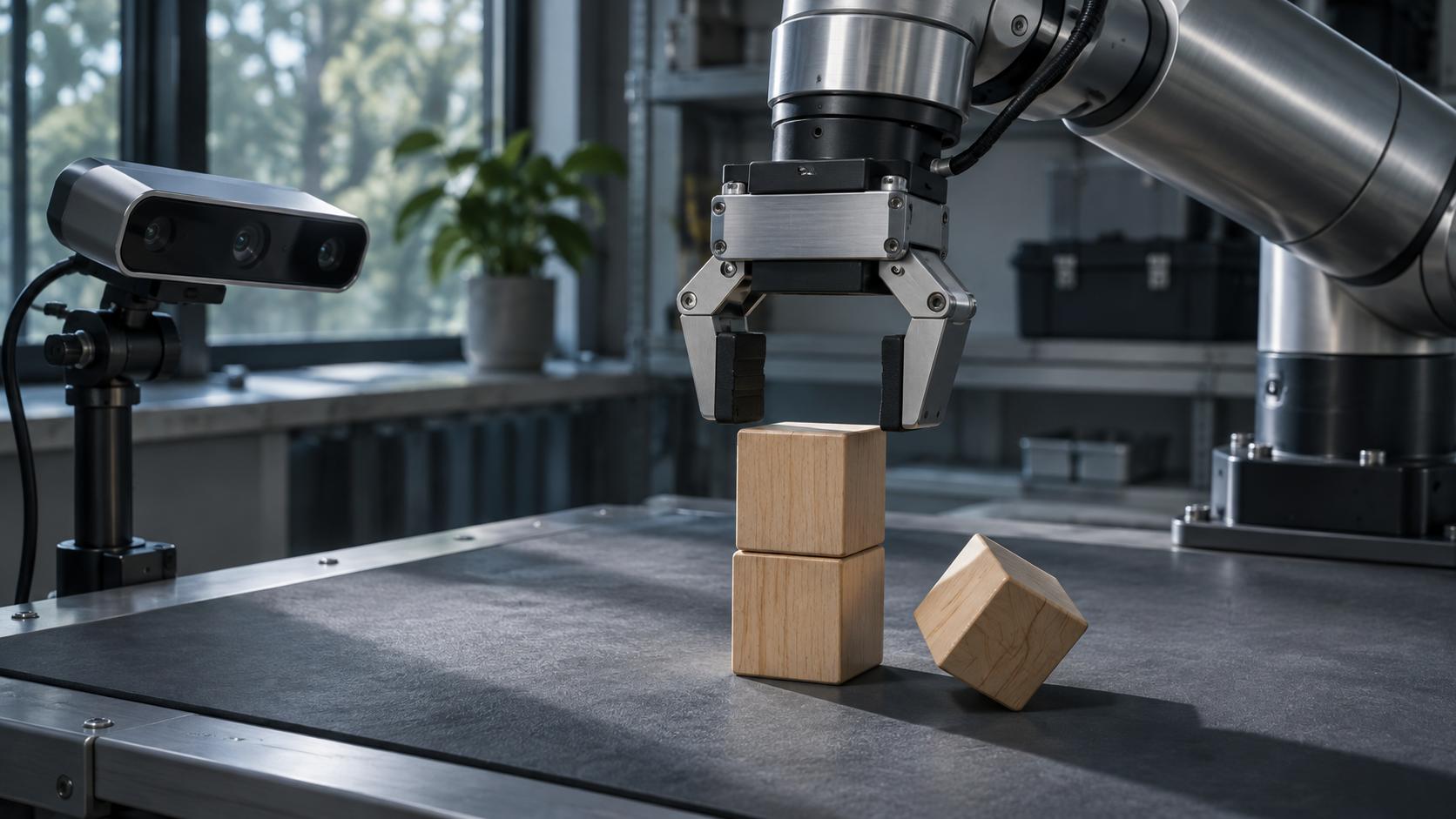
🤖 Ai2 has released ToyBlocks, an open robot-learning environment built around an arm, a table and lettered blocks. It generates tasks and training demonstrations automatically, lets researchers vary specific conditions and records where a system fails. Code, data, trained models and evaluation tools are available.
🔠 To spell a three-letter word, a robot has to find the right blocks, inspect hidden faces, turn them correctly and plan a stack. ToyBlocks lets researchers examine those steps separately. One model can choose the next action while another controls the movement, helping distinguish a mistaken plan from poor execution.
⚙️ A task-and-motion planner builds demonstrations from short skills such as pushing, turning, flipping and picking. Hundreds of plans can run in parallel on one GPU. Ai2 reports generation at up to 24 times real time. Its initial release contains 85,336 longer demonstrations, each comprising roughly six to twelve skills, with nearly 1,600 hours of execution and 144 million frames.
🎛️ Researchers can vary block sizes, table height and other physical properties. Training on one side of the workspace and testing on the other reveals whether a model can cope with unfamiliar geometry. Training on selected stack heights tests whether it can combine familiar movements into a new arrangement. Letters and pictures make some tasks require inspection before acting.
🧪 In a search-and-spell experiment, half the scenes lacked a required letter. The agent had to complete the word or identify the task as impossible. It did so correctly on 63 percent of tasks. Confusing similar letters and placing them in the wrong orientation were common failures. In a separate experiment, letting an agent investigate and write descriptions of its tools raised success from 24 to 63 percent.
🦾 Ai2 also checked transfer to a physical robot. Individual ManiFlow skills achieved similar success in simulation and reality. Complete three-block tasks scored 55.5 percent in simulation and 50 percent across 30 physical trials. The real setup uses a Franka FR3 arm, a Robotiq gripper and two cameras.
📦 The release includes simulation assets, task and demonstration generators, recordings, two trained models, training code and evaluation sets. More skills and fully integrated reinforcement-learning training are planned. The practical offer is a controlled setting where a research team can change one ingredient and measure the result repeatedly.