📰 Linguadrop: read today's news at your own language level, in 61 languages
In brief
- 📰 The web app Linguadrop uses AI to rewrite real news at the learner's CEFR level, from pre-A1 to C1.
- 🌍 61 languages, with a translation next to every story; local news from your own country can be added.
- 🃏 Saved words are practised with spaced-repetition flashcards and quizzes.
- 💶 From $5 a month with a 30-day trial; a sample lesson works without an account.
📰 Linguadrop is a browser-based language-learning app that uses current news as reading material. According to the maker's page, it rewrites real news stories at the learner's level on the Common European Framework of Reference (CEFR), from pre-A1 to C1, in 61 languages. Each story shows the translation in the reader's own language alongside it. While reading, learners save unknown words to a personal dictionary. The app then tests them with spaced-repetition flashcards and asks quiz questions about the text. New stories arrive every day. Users who give their country also get stories from local outlets, rewritten in the language they are learning. 💶 A five-minute sample lesson works without signing up. Plans cost $5, $9 or $15 a month, each with a 30-day trial that requires a card. The cheapest plan is limited to one language and level B1. The app suits people who already have some basic vocabulary and would rather read about real events than textbook dialogues. Anyone who mainly wants to practise speaking or listening will find it is mostly reading material.
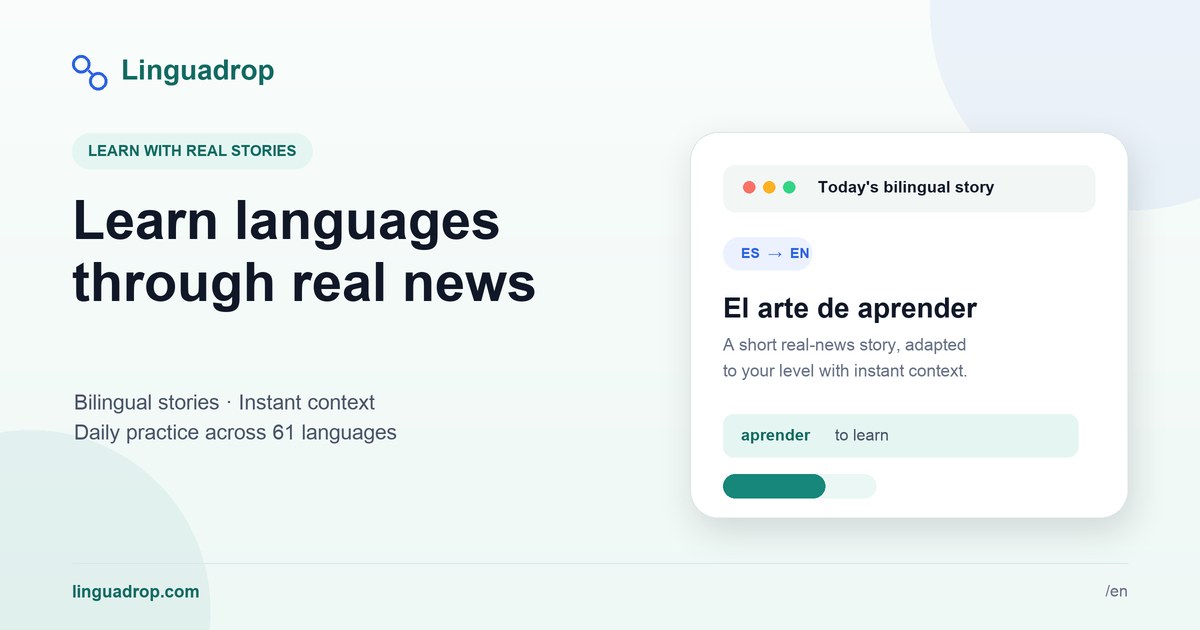
🧭 **How a lesson works.** Learners start by choosing a target language and a level; anyone unsure of their level can, according to the maker, take a short placement check with five reading questions from A1 to C1 and continue into a matching free lesson. A lesson is a short bilingual story: the app's public library shows, for example, an obituary of the physicist Cyril Hilsum and a warning by the head of the IMF about AI demand pushing up interest rates, each as an elementary German lesson with its original outlet named. Key words and a few comprehension questions with instant feedback follow.
🏘️ **Local news.** The less common feature is the one for your own country: give it, and the daily selection adds stories from local outlets there, rewritten in the target language. The page shows Dutch examples, such as a report about a new bicycle bridge in a town centre that turns into a simple Spanish sentence. Learners thus read in the foreign language about things they already know from daily life.
🧠 **Vocabulary.** Saved words go into a review queue that shows each card again shortly before you are likely to forget it. There are also typing drills where you enter the translation, and so-called memory hooks: an AI-generated image for each word and a breakdown into familiar syllables meant to help with pronunciation and recall.
📊 **Open data.** Linguadrop says it publishes a news readability benchmark with methodology and data for 70 public A1 and A2 lessons, plus a dataset of unique-word share, repetition and sentence length across its published lessons, downloadable as CSV and JSON. The maker itself notes that these figures measure the text, not the user's reading level. Other free tools explain, inside the browser only, why a pasted passage feels difficult, and print a lesson as a bilingual classroom worksheet without an account.
💳 **Prices and limits.** Starter costs $5 a month or $40 a year but covers one language and goes up to level B1. Pro ($9, or $72 a year) and Ultimate ($15, or $120 a year) include all 61 languages, and both the learning and the native language can be changed at any time. Billing runs through Stripe; the card is charged after the 30-day trial, and cancelling before then costs nothing. Discover and Diners Club cards are not accepted.
⚖️ **Who it is for.** The texts are machine-rewritten versions of other outlets' reporting; how faithful the AI stays cannot be checked from outside, and for a certificate exam the app does not replace a course with listening and speaking parts. For anyone who wants to read a few minutes a day in a foreign language and loses interest in textbook passages, it offers current material at a fitting difficulty. The free lesson shows without an account whether the format works for you.