🧪 evalkit turns agent traces into reviewed tests and regression runs
In brief
- 🧰 InferEdge offers evalkit, a self-hosted open-source system for improving AI agents.
- 🔍 A coding agent groups failures from real runs and drafts test cases.
- 👥 Domain experts review the cases in plain language; new runs are compared case by case.
- 🖥️ It needs Python 3.12+, Postgres or Docker, and an OpenAI-compatible model.
🧰 [InferEdge](https://www.inferedge.com/) has introduced [evalkit](https://evalkit.inferedge.com), a system that turns an AI agent's real runs into tests so that improvements can be checked. It is licensed under Apache 2.0 and runs on your own servers. The loop works like this: a coding agent such as Claude Code studies runs from production, staging or manual testing, groups similar failures and drafts test cases. Domain experts read each case as a question plus the facts a correct answer must contain, then approve it or send it back. evalkit runs the cases, scores them and keeps the full record of each run. 🔁 After fixes, a comparison shows what got fixed and what newly broke. It is aimed at teams that already watch their agents but still build the path from failure to test by hand. The developers say the project is still quite early.
🛠️ According to its developers, evalkit grew out of their own work. They used Phoenix and Langfuse, which are good at recording traces and managing datasets. The process around evals, agent improvements, regressions and mapping errors to code or prompts still had to be built by hand. The team says it still self-hosts Phoenix, mainly as a database.
📝 A test case is a question plus rubrics of one sentence each. In the documentation's example, the answer has to state how many stores Starbucks operated itself at the end of fiscal 2021. Cases are YAML files in your code repository and can be synced from CI. In the web interface they move from unreviewed to review requested, then to approved or changes requested, with threaded comments and a changelog. A run still executes every case; approval only decides which version is promoted to the production suite.
⚖️ Scoring combines rubrics judged by a language model, built-in checks of tool calls, and your own evaluators written in Python or reached over HTTP. For each run the system keeps messages, reasoning, tool calls, tokens, cost and timing. For failed runs the coding agent is meant to propose fixes that name the prompt, tool description, skill or data source to change. The skills it needs are installed with the command evalkit skills install.
🔌 evalkit accepts traces from agents that emit OpenTelemetry spans following the OpenInference or GenAI conventions. It can also import from Phoenix and Langfuse; Langfuse has to be the cloud service or a self-hosted version 4.59.0 or later.
💻 To try it, the [documentation](https://inferedge-ai.github.io/evalkit/try-locally/) lists the PyPI package evalkit-py with Python 3.12 or newer, plus Postgres 15 or later or Docker with Compose v2. The model endpoint must support tool calls and structured output, for example through OpenAI, LiteLLM, vLLM or Ollama. A sample agent for a made-up company comes with five cases. One asks for a figure the agent does not have and passes only if the agent says so. This starter setup uses a demo password and is explicitly not a deployment.
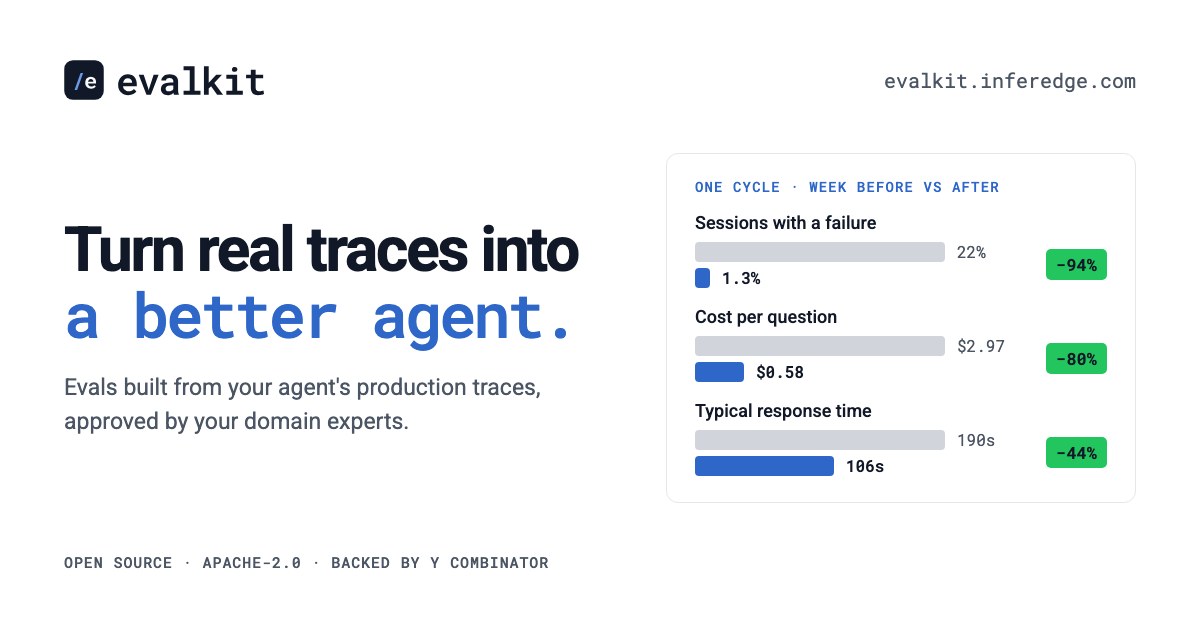
📊 From its own use, the team reports that one issue bucket held 89 traces, evalkit suggested 14 cases, and four pull requests were merged. It says failures fell by 90 percent, token consumption and cost by 80 percent, and time by 45 percent. That is a single in-house example from the maker.
📅 Version 0.9.0 was released on November 25, 2026, eight days after 0.8.0. Anyone upgrading should read the [release notes](https://github.com/inferedge-ai/evalkit/releases): the server and database need updating, and the new server refuses the older command line tool. The code is on [GitHub](https://github.com/inferedge-ai/evalkit).