🩺 One photo of the face: Danish AI model rates death risk in the emergency room better than the standard score
In brief
- 🧑⚕️ University of Copenhagen researchers trained an AI model on 27,660 photos of emergency patients at Herlev Hospital.
- 📊 According to the study it predicts the risk of early death 34 percent better than the Early Warning Score (EWS) used there.
- 🔍 Among patients staff had rated low-risk, it found a group with more than 13 times the risk of dying.
- ⚠️ The researchers stress it is not ready for clinical use and is meant only to support doctors' judgement.
A single photograph of a patient's face is enough for a new AI model from Denmark to estimate that patient's risk of dying early 🩺. Researchers at the [University of Copenhagen](https://www.ku.dk) trained it on 27,660 photos that staff at the Herlev Hospital emergency department had taken to identify patients safely. The model was asked to estimate the risk of death within a day, a week and a month, and the researchers compared its answers with the actual dates of death in the Danish health registers. According to the university, the model was 34 percent better at predicting early death than the Early Warning Score (EWS), which emergency departments use today to grade patients by breathing, pulse, blood oxygen, blood pressure and level of consciousness 📊. Among patients that staff had placed in the low-risk group, it also found a group with more than 13 times the risk of dying. The study is published in *Nature Communications*. The researchers stress that the technology is not yet ready for hospitals and needs further studies. It is meant to add to the judgement of doctors and nurses, not to replace it ⚠️. Other experts point to open questions about consent, data protection and how staff should weigh conflicting risk scores.
🔬 **Where the pictures come from.** In a busy emergency department staff sometimes photograph patients to avoid mix-ups, for example when someone cannot state their own identity or many patients have similar cases. Those are the photos from Herlev, near Copenhagen, that the team used. The patients were followed through the Danish health registers, and 14,127 of them died during the follow-up period, which gives a large number of cases against which the predictions can be measured.
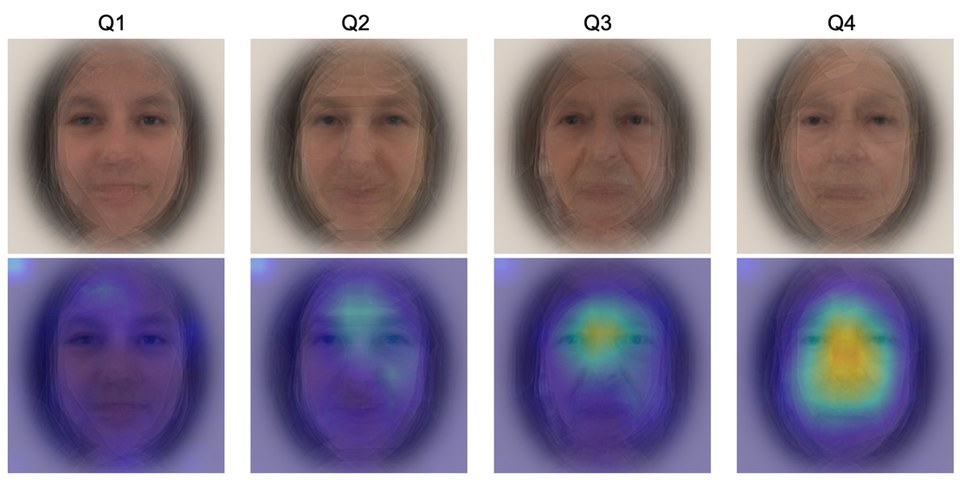
👁️ **What the model looks at.** The analysis suggests the model focuses mainly on the central part of the face around the eyes, nose and mouth, and also takes the complexion into account. It was especially good at picking up heart problems, the lung disease COPD, diabetes and chronic kidney disease, as well as general signs of frailty. Lead author Indra Heckenbach, a former postdoc at the university, thinks it captures a combination of many small signals that are hard to see one by one but together say a lot about a patient's health. Co-author Morten Scheibye-Knudsen, associate professor at the Department of Cellular and Molecular Medicine, compares it with the "clinical gestalt" of experienced doctors who can often tell at a glance who is seriously ill; the model, he says, can quantify many of the same signals.
🧪 **An unusual cross-check.** The researchers also tested the model on photos of well-known people from Wikipedia, where both the date of the picture and the date of death are known. There too, according to the university, it could predict when the people would die.
🧬 **Why ageing research cares.** Scheibye-Knudsen sees a use beyond the emergency room. Ageing research is looking for biomarkers that reflect not a person's age in years but how well the body works. That a single face photo carries signals linked to ageing, age-related diseases and mortality could become a new tool to study how people age, he says.
📱 **Possible uses.** In principle the model could run on an ordinary smartphone. In the long run the researchers think of emergency departments, telemedicine and out-of-hours doctors' services, to see which patients need help most urgently. Speaking to the broadcaster TV 2, Scheibye-Knudsen also named remote places without doctors, such as parts of Greenland, and said the model could be usable within a few years. A photo takes seconds; the analysis takes an instant.
⚖️ **Caution and criticism.** Mads Nielsen, professor at the Pioneer Centre for Artificial Intelligence at the University of Copenhagen, told TV 2 the results were fascinating, but warned that nothing is known about cause and effect and the signals are easy to misread. Victor Vadmand Jensen, a PhD student at Aarhus University and Silkeborg Regional Hospital, asks how staff should weigh an AI score against existing scores, and says patients would need to be told clearly what their photos are used for. Readers of the engineering weekly *Ingeniøren* objected that the photos show older people in a vulnerable situation and were taken for a different purpose. There is also a commercial angle: Heckenbach has since founded a company in the United States that builds clinical AI models to assess health risks.
📌 **What is still missing.** The university itself says that further studies must confirm the results in practice and clarify which physical features the model actually picks up. The model does not predict a date of death for an individual; it gives a statistical risk based on patterns seen in other patients.