🔭 Quantum gravity with GPT-6 Astra: Stanford physicist posts AI-assisted theory, and physicists are split
In brief
- 📄 Venkatesa Chandrasekaran (Stanford, also at OpenAI) posted a preprint on quantising gravity on 25 November.
- 🤖 According to its acknowledgments, several calculations and proofs came from exchanges with GPT-6 Astra, about 400 million tokens.
- ⚖️ Jonathan Oppenheim (UCL) and Peter Woit (Columbia) see no breakthrough; others find it interesting.
- 🔍 The paper is not peer reviewed, covers only gravity without matter and proposes no experiment.
Can an AI help crack one of physics' oldest puzzles? Venkatesa Chandrasekaran, a postdoc at Stanford University who also works at OpenAI, posted a preprint on arXiv on 25 November titled *An algebraic quantization of gravity from the null cone* 📄. It proposes a quantisation of general relativity meant to join Einstein's gravity and quantum mechanics under limited conditions: in a vacuum, in four dimensions, without matter. According to the acknowledgments, several calculations and proofs grew out of months of exchanges with OpenAI's GPT-6 Astra model, totalling about 400 million tokens, with computing power supplied by OpenAI 🤖. OpenAI chief executive Sam Altman congratulated him publicly. Physicists are divided: Jonathan Oppenheim of University College London writes that the work does not even come close to establishing a quantum theory of gravity, and Peter Woit of Columbia University calls it a publicity stunt. Others consider parts of it correct or interesting, but neither new nor testable. The paper has not yet been peer reviewed.
🧩 **The problem.** General relativity describes gravity as the curvature of space and time; quantum mechanics describes the behaviour of the smallest particles. Each works in its own domain, but for about a century physicists have failed to bring them into one framework.
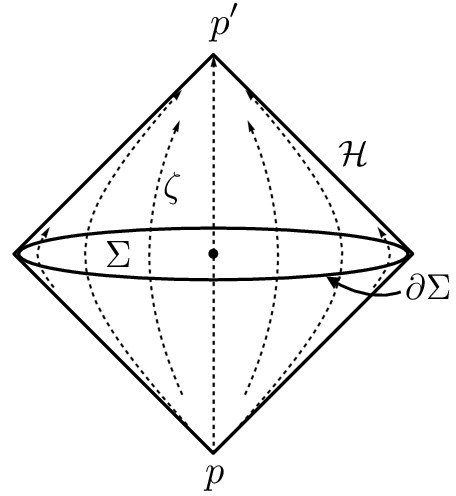
📐 **What the preprint claims.** Chandrasekaran starts from causal diamonds, regions of spacetime enclosed between two light cones. On the surfaces traced by light, Einstein's equations become easier to handle. He first solves the constraints of gravity there classically and then quantises what is left. The abstract lists, among other results, a path integral in which every sum over intermediate states converges, a finite value for the creation and annihilation of a graviton pair where an approximate calculation gives infinity, a finite number of possible states for a diamond of a given size, the Bekenstein-Hawking entropy of black holes with a correction that the physicist Ashoke Sen had obtained another way, and Einstein's equations as the low-energy limit. The paper runs to 54 pages plus appendices and is framed as a proposal.
🤖 **The AI's part.** The text does not say which steps came from the model and which from the author. In the acknowledgments Chandrasekaran thanks Sam Altman, Sebastien Bubeck and other OpenAI staff for the computing power and their encouragement. Altman wrote on X that Chandrasekaran had been one of the earliest believers that the company's model of the time could be used to solve Millennium Prize problems.
⚖️ **The criticism.** Oppenheim, who works on a competing approach himself, calls it serious work but a false alarm. According to an account on the blog of Pasquale Pillitteri, he objects among other things that the symmetry of general relativity is imposed as an assumption and that the operator meant to govern how the system evolves in time is never constructed. He had a swarm of Claude agents from rival Anthropic check the paper; by his account they found more than a dozen weak points, although that machine review itself has not been checked by a human. Until there are other ways to separate real signals from cheap AI slop, there will be more false alarms, he wrote. Woit wrote on his blog that he has seen thousands of similar claims and none held up; the only thing different about this one is that a machine wrote it and a company paid for it.
🔬 **The middle ground.** Theoretical astrophysicist Hontas Farmer of Chicago State University wrote on X that the paper holds up to scrutiny but proposes nothing testable in experiments and overlaps with ideas already published. Physicist Nirmalya Kajuri sees no solved problem but real contributions to the theory, and noted that before AI such a paper would hardly have drawn this much attention.
📌 **Context.** Unlike mathematics, where proofs can be checked step by step by programs such as Lean, theoretical physics has no such tool: a correct calculation can rest on an unproven assumption. Whether the proposal holds up is now for peer review to show.