🎬 AI can animate graphics, but timing and movement instructions still trip it up
In brief
- 📊 MotionGraphicsBench checks 100 animation tasks against measurable requirements.
- 🧪 Only four of 32 tested models pass more than half the tasks on their first attempt.
- ⏳ Motion paths, positions and coordinated event timing remain frequent failure points.
🎨 An animation can look convincing while getting the instruction wrong: an object moves too early, ends in the wrong place or follows the wrong path. Figma and Stanford introduce MotionGraphicsBench to test those details. It starts with complete vector artwork and checks whether a model implements the requested motion.
📐 A typical animation demo shows that a model can produce something that moves. MotionGraphicsBench begins with a more specific assignment. The model receives a complete static SVG graphic and an editing instruction. It must add the requested motion while preserving the existing design.
📏 The release contains 100 expert-reviewed tasks covering 17 requirement types. These include positions at particular moments, trajectories and relationships between events. An executable check can establish whether an element reaches its target and whether a second movement waits for the first one to finish.
🏆 The researchers test 32 models from twelve providers. Only four exceed a 50 percent first-attempt pass rate. GPT-6 Astra at maximum reasoning records the highest reported result, 67.7 percent. Even that configuration misses a substantial share of the requested edits.
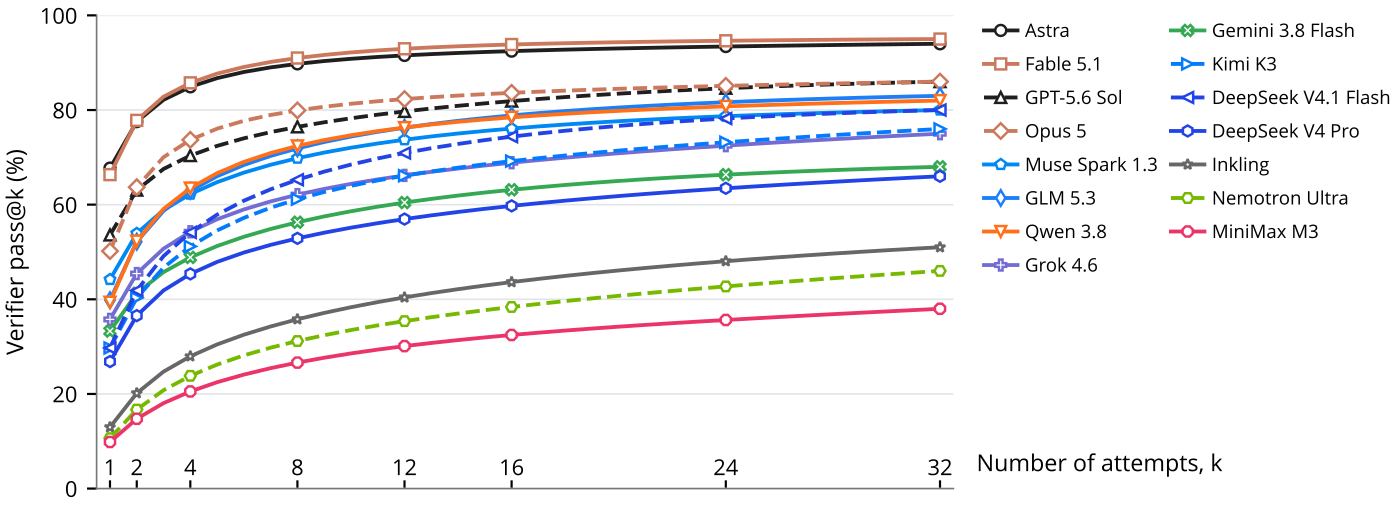
🔁 For 15 models, the study also evaluates up to 32 independent attempts per task. Counting a task as solved if any attempt passes produces results ranging from 38 to 95 percent. More attempts can help, but an application also needs a reliable way to identify the successful one.
🔧 The benchmark uses human-readable verification programs for that purpose. A multi-agent pipeline constructs them from the task requirements, with human judgments used to assess their reliability. On 180 held-out animations, the programs agree with human judgments in 93.3 percent of cases. A vision-language-model judge used for comparison agrees in 83.3 percent. These figures measure the evaluators rather than animation-generation success.
🔗 The authors link tasks, code, examples and a research manuscript. For design tools, the benefit is a more precise quality check: a system can test whether timing, motion and layout match the request instead of relying only on an attractive preview. Spatial and temporal instructions remain prominent failure points in the models studied.