🧮 Anthropic and OpenAI both publish AI-made proofs on the 1979 VP versus VNP problem
In brief
- 🧮 Anthropic and OpenAI each posted a proof on GitHub that VP is not equal to VNP, an algebraic cousin of P versus NP.
- ⏱️ Anthropic's came about six hours before OpenAI's; both come with Lean 4 formalizations.
- 🔎 No human mathematician has reviewed either proof yet; researchers call it striking but ask for time.
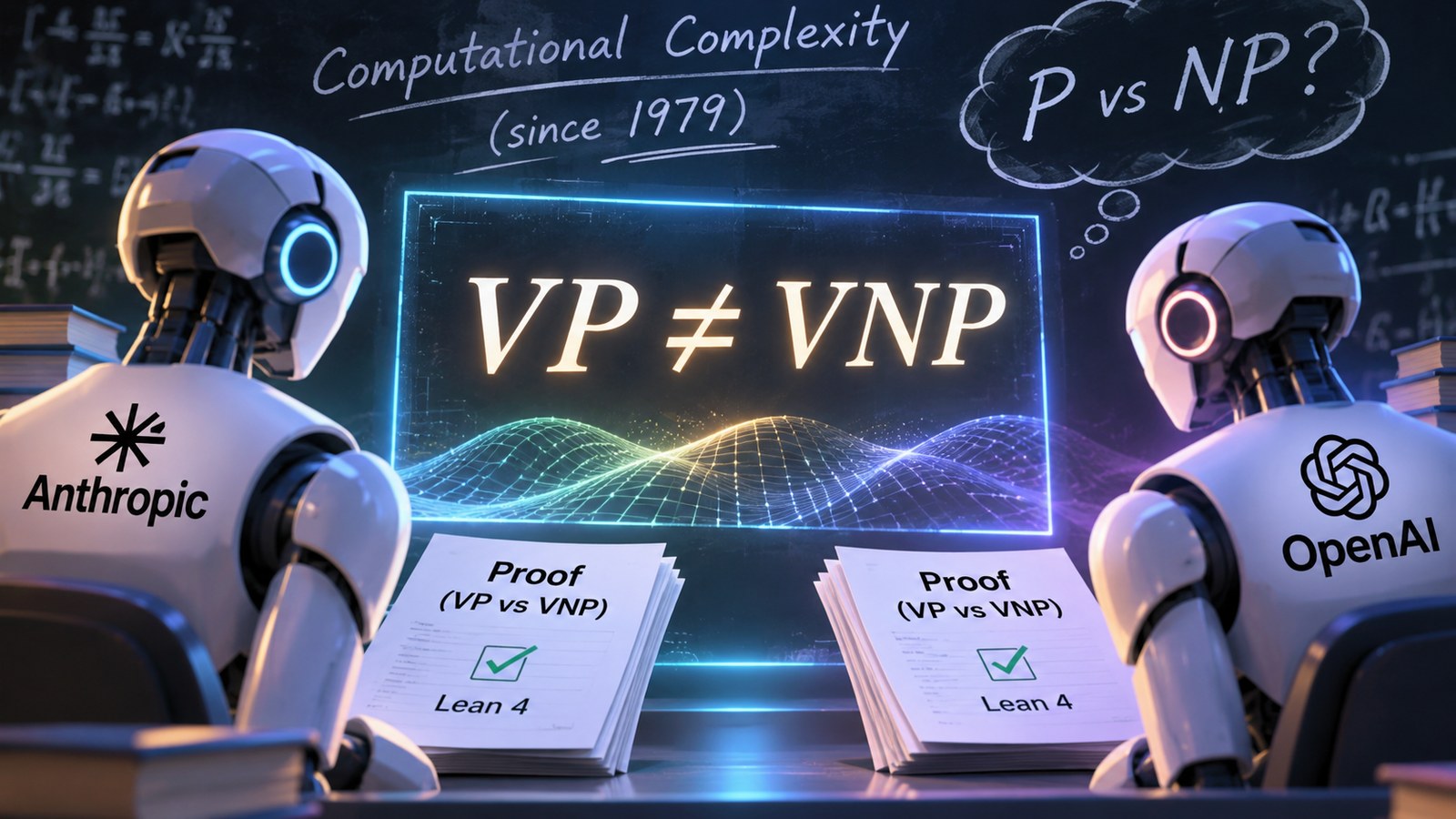
Anthropic and OpenAI have independently published proofs on the VP versus VNP problem, which Leslie Valiant posed in 1979. Both papers argue that VNP is not contained in VP, meaning certain polynomial computations cannot be done efficiently by small arithmetic circuits. 🧮 Anthropic says an internal research version of Claude wrote its proof, the paper and a Lean 4 formalization; it acknowledged that no human mathematician has reviewed it. OpenAI followed with its own paper and formalization. Researchers welcome the results but stress that the mathematical community needs time to check them.
The two uploads are easy to mix up with the better-known P versus NP question, so the difference matters. VP and VNP are complexity classes for computations over polynomials, not for yes/no problems on binary strings. A statement that VP is not equal to VNP says that some polynomial families, in the strong sense of the problem, need arithmetic circuits that are far larger than any efficient method allows. 🔬 That is a lower bound, and lower bounds are the hard direction: showing that something can be computed quickly needs one good algorithm, showing that it cannot be computed quickly needs an argument against every possible one.
According to Notebookcheck's report, Anthropic put its findings on GitHub without much fanfare. The work, including the accompanying paper, came from an internal research version of its Claude model, together with a formal verification in Lean 4. Lean is a programming language in which a proof is written as code, so that a computer can check each logical step. Anthropic acknowledged that no human mathematician had yet looked at the proof. OpenAI then published its own paper on GitHub the same day, also with a Lean 4 formalization. The report says the two proofs differ in several important respects and notes from the upload timestamps that Anthropic's appeared roughly six hours earlier. The report does not detail how the two approaches differ.
A machine-checked formalization does not settle everything. It shows that the code proves the statement as written in Lean, but humans still have to confirm that the formal statement really captures the VP versus VNP question and that the definitions are the intended ones. That is why the report keeps repeating the word *independent*: both claims need scrutiny before they count as established results.
The researchers quoted in the report are positive and careful at once. Tom Gur of the University of Cambridge called the progress unprecedented and said that decades of mathematical work appeared to have advanced within days, but added that the community needs more time to study the proofs and see how widely the techniques apply. Varun Kanade of the University of Oxford thinks the results could bring researchers closer to solving P versus NP, while expecting that new techniques will still be required. Ben Livshits of Imperial College London pointed to the broader questions this pace raises for theoretical computer science and for the role of AI in mathematical research. 🤔
The news arrives in a week of heated claims. Notebookcheck mentions a reported AI-assisted proof of the Riemann hypothesis; The Register describes that claim as a researcher's own note, written with Claude's help, published as Lean code and an unreadable 250,000-page text that its author himself called slop, and it quotes mathematicians asking whether a proof that nobody can read is real understanding. That is a separate claim from the VP versus VNP papers, but the question of legibility applies to both. 📚
For readers, the practical conclusion is modest: two companies say their models produced proofs of a 47-year-old problem, formal checkers have been run on the code, and human experts have not yet confirmed the mathematics. Until they do, treat the results as claims.