🛰️ China's ADA Space says its satellite trained Alibaba's Qwen3-32B in orbit for 45 minutes
In brief
- 🛰️ ADA Space's Libra satellite trained Alibaba's language model Qwen3-32B in orbit.
- ⏱️ One continuous training run lasted 45 minutes 33 seconds, measured by China's state-run CAICT institute.
- ❄️ A 10-kilowatt liquid cooling loop with deployable radiator wings made the long run possible.
- 🌐 ADA Space plans 2,800 computing satellites; its second group of eight launched on October 14.
🛰️ Chinese satellite operator ADA Space (Adaspace) reports a record for AI training in space: its Libra satellite trained Alibaba's open language model Qwen3-32B in orbit, with forward and backward passes, gradient calculation and weight updates all done on board. One continuous run lasted 45 minutes 33 seconds, with the training loss falling steadily. The figures come from tests by the China Academy of Information and Communications Technology (CAICT), a state research institute, as reported by Science and Technology Daily on November 26. The satellite is rated at 32 PFLOPS at FP8 precision. ❄️ The key is cooling: in a vacuum, heat can only be radiated away, so computing loads in space usually run only briefly. ADA Space uses a liquid cooling loop for about 10 kilowatts and large deployable radiator wings. The company compares the run with Google's in-orbit TPU prototype, whose single runs are about 15 minutes according to public information. The eight satellites of the second group reach almost 50 POPS together; 2,800 computing satellites are planned.
🔬 **What exactly was measured.** According to Science and Technology Daily, the newspaper of China's science ministry, CAICT has published the first third-party in-orbit test data for the second satellite group of ADA Space's "Star Compute" plan. It names three results: the Libra satellite verified training and inference of Qwen3-32B; the cooling system sustained a computing load of about 10 kilowatts in continuous operation; and training ran without interruption for 45 minutes 33 seconds during a single orbit. According to the report, Qwen3-32B, with about 32 billion parameters, is the largest model trained in space on public record. Until now, AI experiments in orbit were mostly limited to inference or light fine-tuning.
🌡️ **Why heat is the real problem.** On Earth, air or water carries the waste heat away from computer chips. In a vacuum there is no convection; heat can only leave as radiation. That is why high-performance computers on satellites usually run briefly and with breaks. ADA Space built its own liquid loop in the ten-kilowatt range that moves the heat to very large radiator wings unfolded in orbit. The newspaper stresses that many satellite computing figures are calibrated on the ground, while light, temperature, radiation and power fluctuations limit usable performance in orbit, which is why independently measured in-orbit data matters.
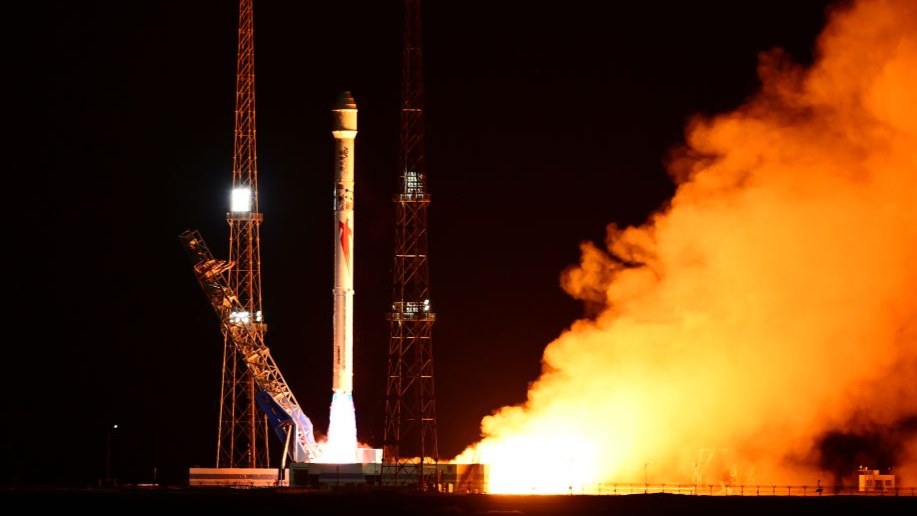
📡 **The satellites.** The eight satellites of group 02 lifted off on October 14 on a Zhuque-2E rocket from the launch area near Jiuquan in northwest China. According to China Daily, they carry computing payloads, laser terminals for links between satellites and to the ground, and low-light cameras; they fly in a dawn-dusk orbit that gives them almost constant sunlight for power. The first group of twelve satellites launched in May 2025. Together, the constellation reaches almost 50 POPS (peta operations per second), the company says.
🌐 **The bigger plan.** ADA Space wants to put 2,800 computing satellites into orbit: 2,400 for inference and 400 for training. The case for data centres in orbit: on Earth, power and land for AI data centres are getting scarce, while in space solar energy is available almost without interruption. Google is also pursuing the idea with an in-orbit TPU prototype.
⚖️ **How to read the figures.** The results come from the company and a Chinese state institute, not from an international testing body. The comparison with Google's 15-minute runs rests on publicly available information, according to the newspaper. The reports do not say how many training steps ran in the 45 minutes or whether this was full training or a part of it. A model of this size is trained on Earth for weeks on thousands of chips; the run in orbit is a technical proof, not a substitute for that.