🔭 Two amateur astronomers use Codex and Astra to find new exoplanet candidates
In brief
- 🔭 Two amateur astronomers searched public telescope data for planets with OpenAI's AI tools Codex and Astra, OpenAI reports.
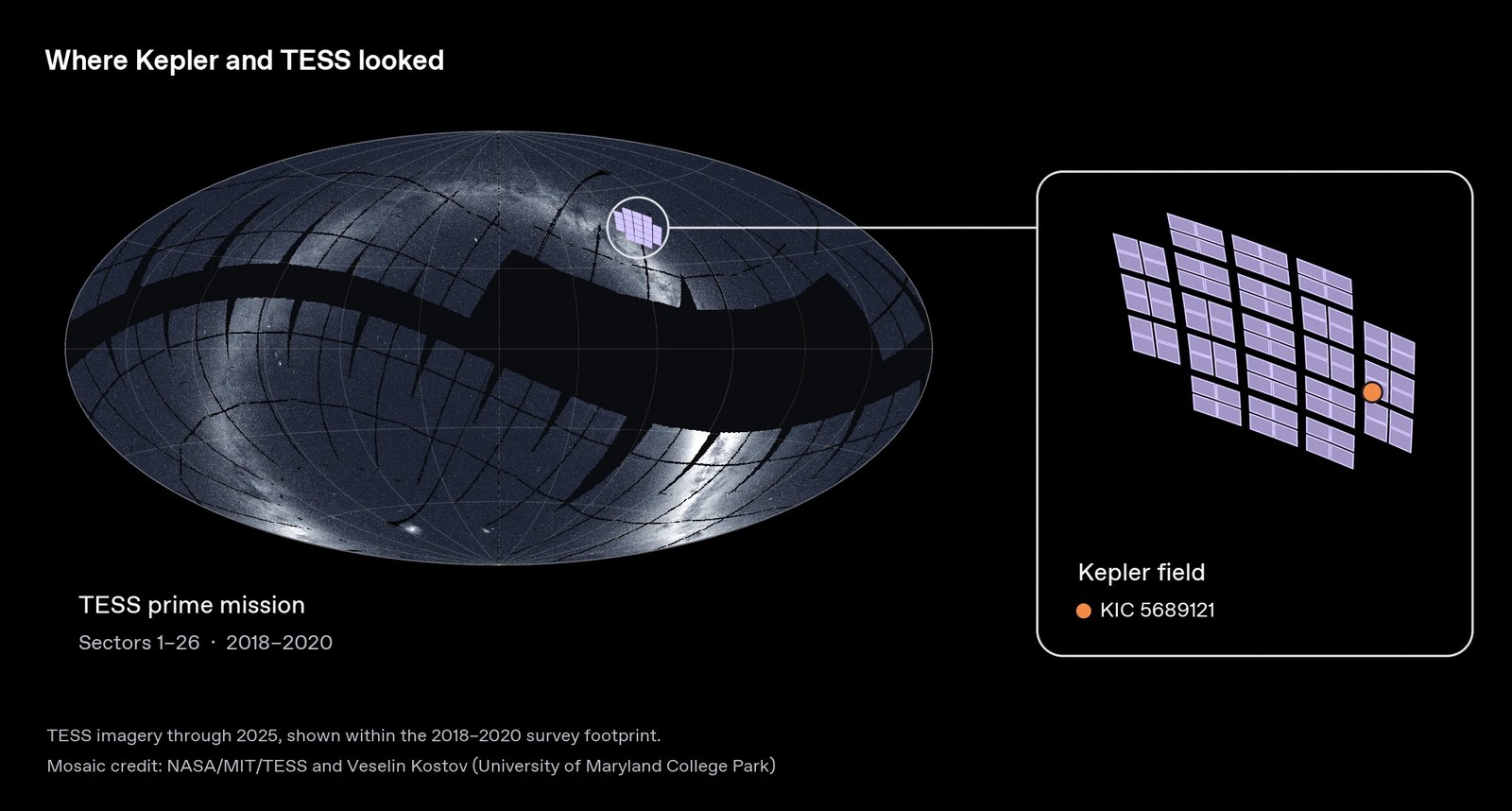
- 🌌 Kevin Bond, an OpenAI engineer, scanned about 100,000 Kepler stars; a SETI Institute astronomer independently found two of his signals.
- 🪐 Ethan Byrd searched data on about 19 million stars and found 49 candidates.
- 🧪 No planet is confirmed yet: that can take months or years.
🔭 Two amateur astronomers have used AI tools from OpenAI to search public telescope data for distant planets and have handed several leads to professionals. [OpenAI](https://openai.com/index/searching-for-distant-planets-with-astra/) reports it in a post of November 24; the company is not a neutral party, since one of the two works there. Kevin Bond, an engineer at OpenAI, had Codex build a search program and ran it on observations of about 100,000 stars from the Kepler space telescope. An astronomer at the SETI Institute found two of his signals again in an independent search. Ethan Byrd, founder of the start-up Primitive, used Astra on data from about 19 million stars from TESS and other archives; the first pass turned up 49 candidates, and he has handed one of them to researchers of the TESS mission. 🌌 The important caveat: these are candidates, not discovered planets. A dip in starlight can have other causes, and confirmation through further observations and a peer-reviewed paper can take months or years.
🌠 **How the search works.** Both used the transit method: when a planet passes in front of its star as seen from Earth, it blocks a tiny part of the light. In the light curve, the star's brightness over time, that shows up as a small dip; if it returns at regular intervals, the next crossing can be predicted. Many of the obvious signals in the old data were found long ago. The AI is meant to help find fainter patterns in data that has already been searched. The approach itself is not new: in 2017 researchers trained a neural network on 15,000 vetted Kepler signals and used it to find an eighth planet around the star Kepler-90, OpenAI recalls.
🛠️ **Bond's toolkit.** Bond, who came to astronomy through night-sky photography, had Codex compare published search methods, combine them into one program and test whether changes to the code improved the search. One AI agent scanned the light curves, a second ran closer checks on the candidates the first flagged. The search reported more than 200 signals, 10 of them from planets already confirmed; seeing those again gave Bond confidence in his program.
🪐 **Two stars stand out.** KIC 5689121 is a cool star in the constellation Lyra, about half the size of the Sun. It dims slightly every 13.8 days; if a planet is the cause, it would be about 2.4 times Earth's diameter. In the faint star KIC 6691030 in the northern sky, the dip returns every 4.8 days, consistent with a planet smaller than Neptune. These are the two signals the SETI Institute astronomer found independently. Vishal Gajjar, associate director for international SETI programs there, says in OpenAI's post that Bond's pipeline surfaced promising candidates in the Kepler Bonus Catalog that traditional searches may have missed; initial checks are encouraging, and follow-up observations will tell more.
🌍 **Byrd's search of the habitable zone.** Byrd tried several AI models before settling on Astra. He had it review methods from the literature, build the software and run first checks. One of his two searches looks broadly for candidates, the other at the habitable zone: the distance from a star at which a planet with a suitable atmosphere could hold liquid water. Besides the strongest candidate, which awaits analysis at the TESS mission, two more are to be submitted; the search is still running.
⚠️ **What else a dip can be.** Two stars eclipsing each other produce a similar signal, and even a temperature change aboard a telescope can affect the instruments enough to make a star appear dimmer. Professionals therefore show statistically that a planet is the most likely explanation, or collect more data, for example by radial velocity: a planet's gravity tugs on its star, which moves slightly toward and away from us, shifting the colour of its light a little. At the end comes a peer-reviewed paper. For the star in Lyra this means, concretely, that astronomers can watch for the next expected crossing.
🔎 **Who is telling the story?** The source is a post by OpenAI that also shows off its own tools; Bond is an employee of the company. So far only the two Kepler signals have been checked independently, by the SETI Institute, not Byrd's 49 candidates. The podcast Intellectually Curious also picked up the story on November 27, but adds nothing beyond OpenAI's account.
🧑🚀 **Joining in.** OpenAI points to programmes that need no telescope of your own: NASA's Exoplanet Watch lets anyone request data and plot light curves. Those with a telescope can join observing campaigns through Exoplanet Watch, the AAVSO Exoplanet Observing Program or the Unistellar network.