📐 OpenAI claims an answer to Smale's ninth problem on linear programming – review still pending
In brief
- 📐 An OpenAI manuscript describes a strongly polynomial algorithm for linear programming
- ❓ That would answer Smale's ninth problem, posed in 1998
- 🧩 A companion paper claims to disprove the polynomial Hirsch conjecture
- 🧪 Per the change log, Lean covers only selected results of each manuscript
- ⚠️ OpenAI calls the papers raw research data and says unformalized results could have issues
📐 OpenAI has added nine manuscripts to its mathematics repository, two of them on optimization. According to the change log, one gives a **deterministic strongly polynomial algorithm for linear programming** and so answers the ninth problem that mathematician Stephen Smale put on his list of open questions in 1998. The other is said to disprove the **polynomial Hirsch conjecture** about paths along the edges of many-sided solids. ⚖️ Both are claims by the company. The log mentions Lean formalizations only for selected results of each manuscript. OpenAI itself describes the collection as raw research data from an unreleased internal model rather than polished academic papers.
❓ **What Smale asked for.** The task is a strongly polynomial method that decides, for a matrix A and a vector b, whether some x satisfies Ax ≥ b. Such systems of linear inequalities are the core of linear programming. “Strongly polynomial” is the stricter demand: the number of calculation steps should grow polynomially with the number of constraints and variables alone, no matter how long the input numbers are.
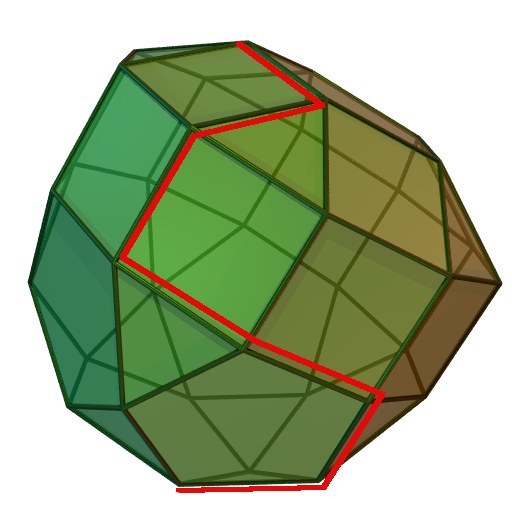
📏 **The second result** is titled “Superpolynomial graph diameter of simple polytopes”. A polytope is a solid bounded by flat faces, in any number of dimensions. Its graph diameter says how many edge steps the shortest route between two corners needs in the worst case. In a 1957 letter to George Dantzig, Warren Hirsch conjectured that with n faces in d dimensions the answer is at most n minus d. That original version has been known to be false since Francisco Santos announced a counterexample in 2010: a solid in 43 dimensions with 86 faces.
The weaker, polynomial version stayed open: the diameter grows no faster than some fixed power of the number of faces. The new manuscript claims to disprove exactly that for bounded simple rational polytopes.
🔗 **Why the two belong together.** The well-known simplex method walks from corner to corner of such a solid toward the best solution. The diameter therefore sets a lower limit on how many steps an edge-following method needs in the worst case. A superpolynomial diameter would mean that even the best possible choice of route along the edges of such a solid could not always get by with polynomially many steps. That is context from the known geometry; the change log does not say how OpenAI's algorithm proceeds.
🧪 **State of verification.** For the nine manuscripts, seven of them on the geometry of tensors, including the previously reported matrix multiplication claim, the log cites Lean proofs of “selected results”. Lean is software that checks proof steps by machine. The wording does not establish that the two main optimization theorems are fully confirmed formally.
🤖 **Origin.** The [project page](https://github.com/openai/math) attributes the manuscripts in the collection to an unnamed internal model at [OpenAI](https://openai.com). The vast majority of results came from one procedure, using on average the equivalent of three hours of ChatGPT Pro thinking compute per result, and the model was posed roughly 4,000 problems. The page does not say separately whether exactly this applies to the two new optimization papers.
⚠️ The team also warns that unformalized results could have issues, which it intends to fix quickly, and says it defers to the mathematical community on credit and precedence. Corrections do happen: elsewhere in the log, OpenAI withdrew three algebraic geometry manuscripts because of a sign error.
🔭 What counts now is whether specialists can follow the algorithm and the counterexample.