🎬 Claude and Codex reach the Netflix Prize target after two months of agent work
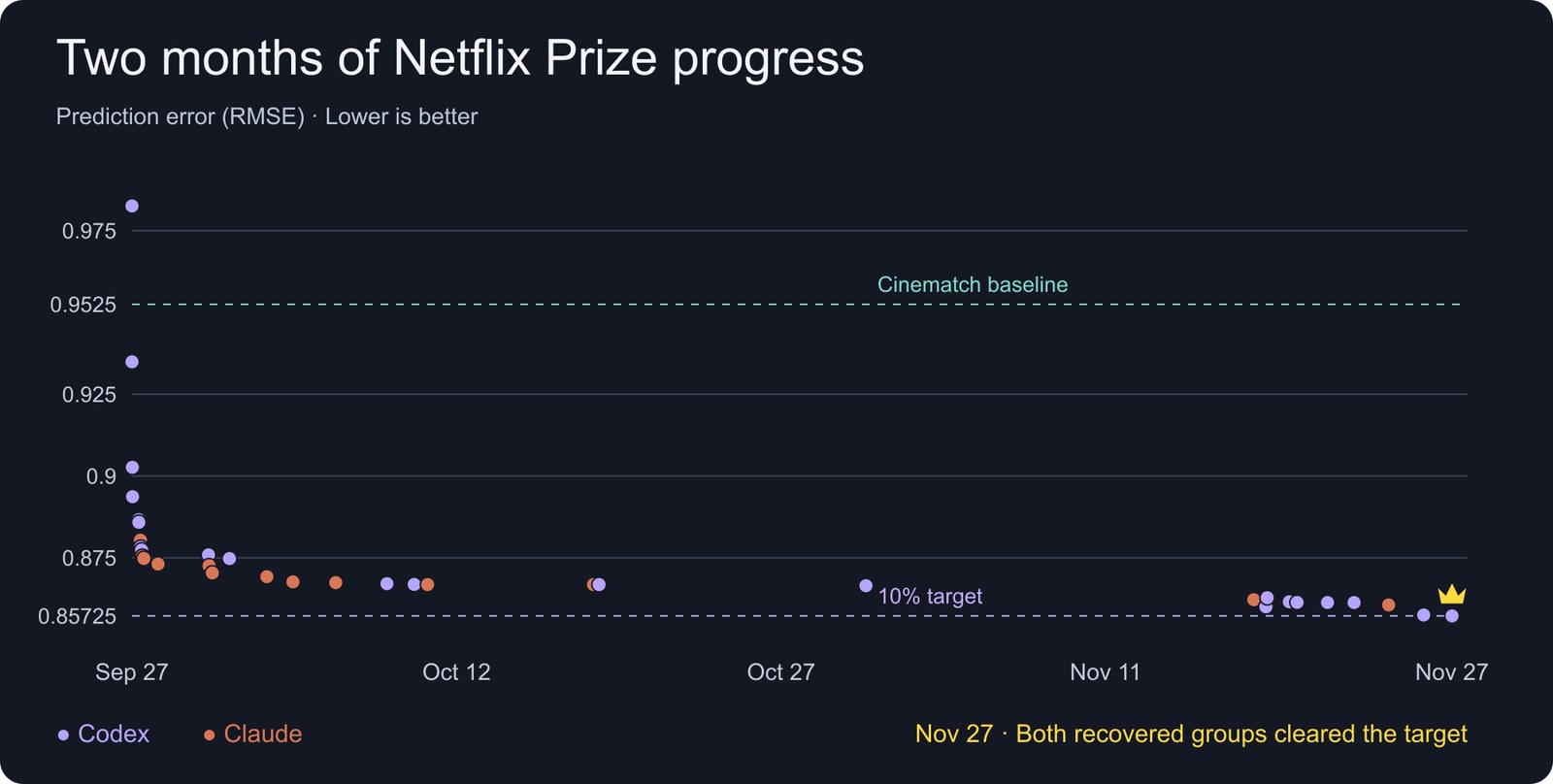
In brief
- 🤖 A developer had the AI agents Claude and Codex work on the 2006 Netflix Prize for two months.
- 🎯 His ensemble reached an error (RMSE) of 0.857244 by his own account, just under the 10% target of 0.85725.
- ⚠️ It was scored on community-recovered ratings, not officially; the 2009 winners reached 0.8567.
- 🧭 The breakthrough came when an agent broke an overly strict project rule.
🎬 The Netflix Prize, run from 2006 to 2009, was one of the most famous machine-learning competitions: one million dollars for a method that predicts film ratings 10% more accurately than Netflix's own system, Cinematch. A developer who goes by [mquan](https://github.com/mquan/netflix_challenge) on GitHub has now had the coding agents Claude (Anthropic) and Codex (OpenAI) work on it for two months. By his own account, the agents' ensemble went below the target on November 27: the higher of two measured error scores was 0.857244 RMSE, just under the goal of 0.85725. 🎯 The comparison has limits the developer names himself: the score does not come from the long-closed official contest but from ratings the community recovered afterwards, after several audit runs. The winning team, BellKor's Pragmatic Chaos, did slightly better in 2009 with 0.8567 on the secret test set. The case is interesting mainly as an example of how far AI agents get on a real research task today and where they still need guidance.
🧑💻 How it started. The developer writes that he worked on the Netflix Prize himself 20 years ago and came nowhere near the goal. He expected the task to be solved within a week on a $20 ChatGPT plan. Instead Codex kept hitting rate limits; he upgraded to a more expensive plan and eventually added Claude. He built his own tools to let the agents collaborate.
🧭 The rule break that helped. For a month progress was slow. Then a Claude session by mistake ignored the project's rules for promoting scores and trained much harder on a model that would otherwise have been dropped early. That brought the improvement. The rule was too strict and short-sighted, the developer writes: the agents abandoned sound strategies too early, although some results get worse before they get better. The bend is visible around November 16 in the project's timeline.
📈 The road to the target. The project records 110 milestones. On day one, September 27, a simple model of user and movie biases scored 0.98257 RMSE on the probe set, temporal effects took it to 0.93492, an SVD++ factor model to 0.90267. Neighborhood models, gradient-boosting blenders, restricted Boltzmann machines and models with longer rating histories followed. On November 26 the first of the two audit groups went below the 10% mark, on November 27 both. The project explains the last step like this: a time-aware SVD++ model was combined with an item-item neighborhood model that weights a viewer's ratings of related films by whether they came before or after the film being predicted. That moved the error from 0.85725978 to 0.85724395.
🔍 Why the comparison is not one to one. In the original contest only the jury knew the ratings of the qualifying set, which was split into a quiz half for the leaderboard and a test half that decided the winner. The project checks its predictions against ratings the community recovered after the contest and reports the worse of the two groups each time. It concedes that there were several such audits and that these are local measurements, not an untouched test or official scoring. It says the qualifying ratings were never used to train or select models. And by its own description the project implements selected BellKor-style models, not the complete winning ensemble.
🏆 For comparison: 2009. The team BellKor's Pragmatic Chaos, researchers from AT&T Labs, Yahoo, Commendo and Pragmatic Theory, won the prize on September 21, 2009 with a test error of 0.8567, a 10.06% improvement over Cinematch. Rival team The Ensemble had matched the result but submitted 20 minutes later. The code and every milestone of the new project are public on [GitHub](https://github.com/mquan/netflix_challenge); the developer writes that he learned a few new tricks steering agents in a field where he is no expert.