✂️ Shrink AI models without breaking up their cooperating experts
In brief
- 🤝 HOPE accounts for cooperation between internal experts when shrinking language models.
- 📊 In one coding test, Qwen3.5-35B retained roughly its original score after half its experts were removed.
- 📦 The authors release code for calibration, selection and pruning.
🧠 Large language models often divide work between internal specialists. Removing the weakest specialists individually can break useful partnerships. Amazon’s HOPE research method also measures cooperation between experts before deciding which to remove. Its authors report stronger results when shrinking models aggressively and have released the code.
💾 A mixture-of-experts model activates only some of its specialists for each piece of text, but ordinarily keeps all their weights in memory. In the article’s Qwen3.5-122B example, expert networks account for about 95 percent of roughly 250 GB of parameter memory. Just eight experts per layer are used for any one token.
🔢 Pruning permanently removes experts to save memory. Many methods give each expert its own importance score. HOPE additionally measures pairs that are activated together and how strongly they contribute. That helps preserve a useful group even when one of its members looks less important on its own.
🧮 The method collects these observations in a calibration pass. It then solves an optimization problem for each layer to select the experts to remove. The authors say the extra solving step takes around one or two seconds per layer. Pruning itself requires no retraining.
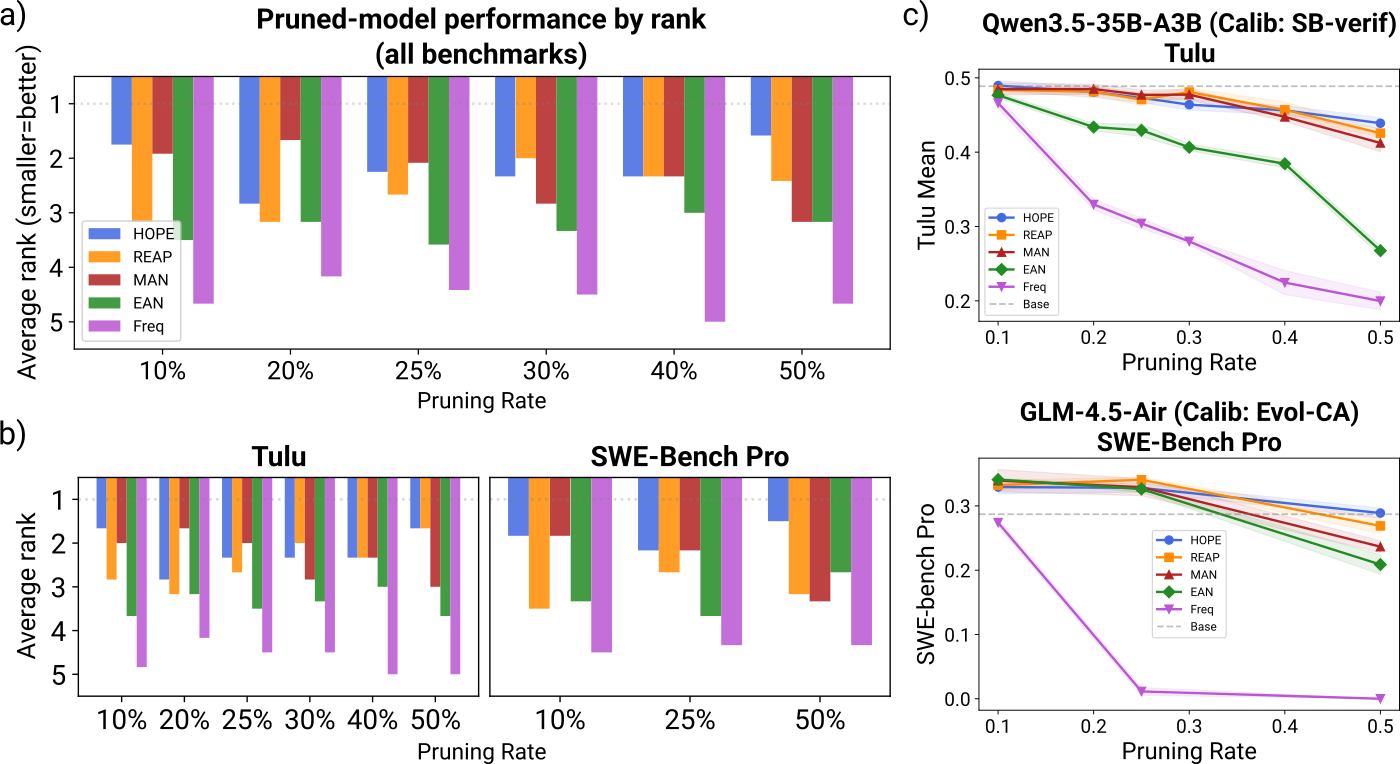
📈 The study tested Qwen3.5-122B, Qwen3.5-35B and GLM-4.5-Air with two calibration datasets and several competing methods. HOPE’s advantage was largest when removing 40–50 percent of experts. In the reported SWE-Bench Pro run, Qwen3.5-35B-A3B scored 42.3 with half its experts removed, compared with 41.8 before pruning and 36.2 with REAP. These are results from the authors’ own study.
🗜️ The released package first gathers model observations, then chooses a pruning set, then writes a smaller standard Hugging Face checkpoint. At lighter pruning rates its advantage was smaller. It also works within each layer, while cooperation across layers remains a research direction.