🌌 AI helps three supercomputers simulate the Milky Way star by star
In brief
- 🌌 A team around RIKEN and the University of Tokyo has simulated the Milky Way down to the level of individual stars.
- 🧮 The largest run used 5.4 trillion particles, about 10,000 times more than previous state-of-the-art simulations.
- 🤖 An AI model predicts how gas spreads after supernovae, making the run about 20 times faster.
- 🖥️ For the first time it ran on the exascale machines Frontier, Aurora and JUPITER, with AMD, Intel and Nvidia chips.
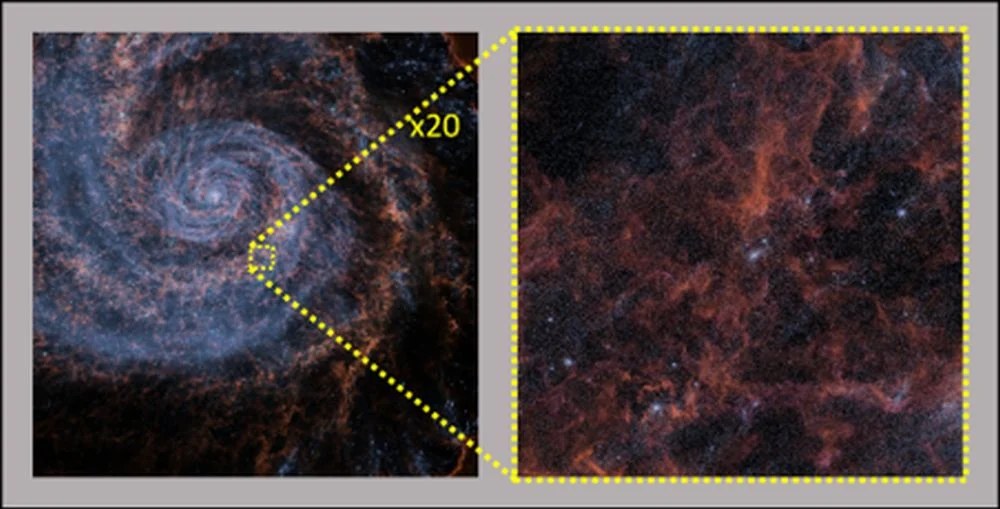
🌌 Researchers led by Keiya Hirashima of Japan's RIKEN institute and Michiko Fujii of the University of Tokyo have simulated the Milky Way in more detail than ever before: each particle of the calculation stands for about one solar mass, in effect a single star. Until now such simulations merged groups of around 100 solar masses into one particle. The largest run used 5.4 trillion particles. 🤖 An AI surrogate model made this possible: instead of calculating the gas cloud after every supernova in tiny steps of about 100 years, it predicts the state after 100,000 years. According to the University of Tokyo, this makes the simulation about 20 times faster. 🖥️ What is new is that the same software ran on three exascale supercomputers with different hardware. The work was presented at the SC26 supercomputing conference.
⏱️ **Why time steps are the problem.** Representing individual stars means capturing fast processes, above all supernovae. When a massive star explodes, it heats the surrounding gas and pushes it outward. Several explosions close together can form huge bubbles of hot gas that trigger new star formation and drive material out of the galaxy's disk. Calculating this directly needs very short time steps, and the shorter the steps, the costlier the run. "When we look at smaller regions in detail, we encounter areas where the gas is denser and changes rapidly," Fujii said in the University of Tokyo's release.
🧠 **What the AI takes over.** Hirashima developed the model that predicts how gas spreads after a supernova. Calculated directly, this needs time steps of around 100 years, he explained; his model delivers the gas distribution after 100,000 years. The whole galaxy can then advance with much longer time steps. In 2025 the same team had already simulated more than 100 billion stars on Japan's Fugaku computer; back then one million simulated years took 2.78 hours instead of an estimated 315 hours the conventional way, RIKEN said at the time.
🖥️ **Three machines, three kinds of chips.** The new step is a technical one: the software, which the team calls PHEASANT, ran on Aurora in the US (Intel processors), Frontier in the US (AMD) and JUPITER at Forschungszentrum Jülich in Germany (Nvidia). Each system needed its own optimisations, Hirashima said. The paper is titled "Architecture-Agnostic Exascale Star-by-Star Simulation of Our Galaxy" and appears in the SC26 proceedings.
🔭 **What it is meant to study.** Fujii wants to understand how individual supernovae affect the number of new stars, the size of gas bubbles and the outflow of material from the galaxy, and how groups of stars become star clusters. Hirashima is interested in the cycle of elements: they form in stars, enter the gas, mix and end up in new stars. As a plausibility check, the team reports that the simulated star formation rate is similar to the one estimated from observations of the real Milky Way.
⚠️ **What is still missing.** A particle of one solar mass is a stand-in for the stellar population, not an exact copy of each real star. And the team has not yet simulated how a galaxy like ours forms from the start; Hirashima names that as the next important step. The authors see the surrogate method as useful in other fields too, such as climate modelling, space weather forecasting and low-temperature plasmas.