⚖️ Can specialist AI answer questions about the EU AI Act better?
In brief
- 🧪 A study tested five specialist assistants and three comparison systems on 110 EU AI Act questions.
- 🏆 Two specialists beat all three comparisons in both test modes.
- 📅 The test used the legal position as of May 1, 2026, and checked citations separately.
🏛️ Five assistants built for regulatory questions competed against three comparison systems on 110 open-ended questions about the EU AI Act. Pharos Labs and Ansvar AI were the only specialists to beat all three comparisons in both test modes. The benchmark scored both the answers and their legal references, using the legal position as of May 1, 2026.
A question about the EU AI Act can look straightforward until the person answering it has to find the right paragraph, identify who has the obligation and explain how an exception works. A team led by researchers and regulatory specialists built a benchmark around that gap. Their paper compares five assistants submitted for a 2026 challenge with three systems used as baselines. Pharos Labs led both versions of the test, followed by Ansvar AI. They were the only two specialist entrants to score above every baseline in both modes.
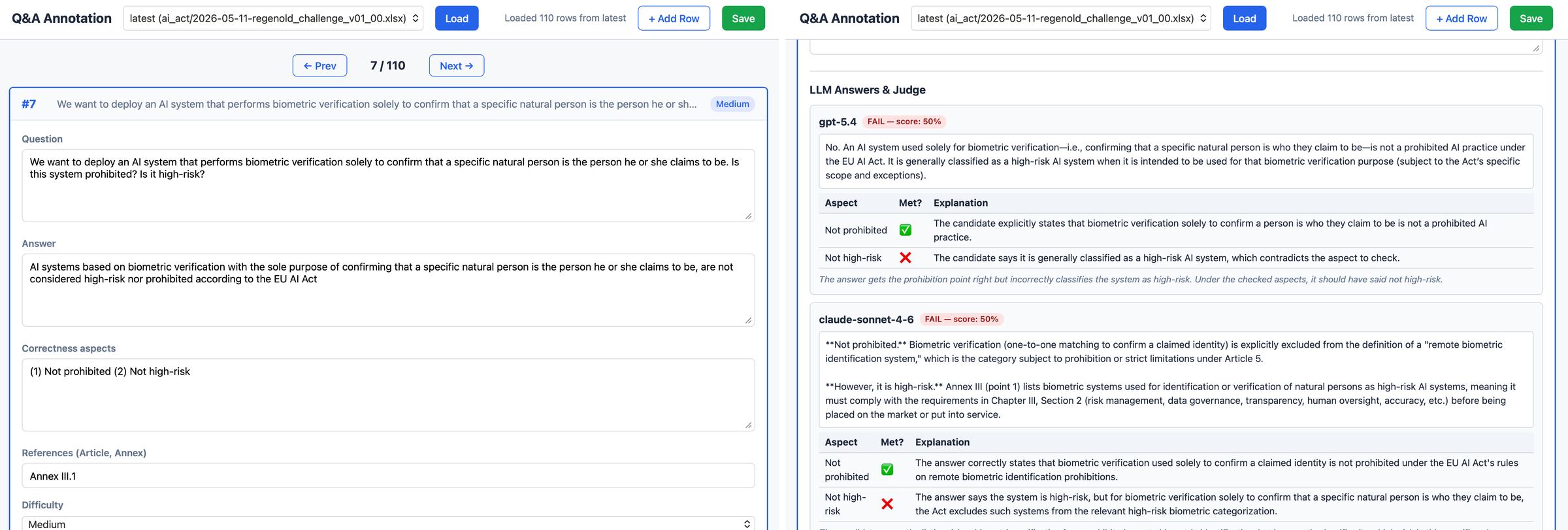
The set contains 110 questions that call for written answers. That matters because a multiple-choice test gives a system the possible conclusions up front. Here the assistant had to decide which facts were relevant, formulate the answer and return a separate list of legal references. The questions range from definitions in the regulation to situations with several actors, where which role a party plays affects the answer. The evaluators wrote a model answer, a checklist of the points each response should get right and a list of expected articles or annexes for each question. They describe expert writing and review as the main source of the dataset. A language model suggested questions from sections of the regulation, and the authors edited or discarded those suggestions.
💬 There were two ways to take the test. In the first, the assistant answered one question at a time. The second included simulated pushback in a conversation, requiring an answer after the user challenged or redirected the exchange. A system that retrieves the correct rule for the first question may need to return to it when the next message contains a misleading premise. The same two entrants stayed ahead in both modes. Antifragile AI moved relative to the baseline with web search between the two modes, an example of how the ordering can depend on the way a user asks.
📚 A particularly useful result concerns citations. The study distinguishes identifying the right article or annex from identifying the specific part that does the legal work. Suppose a response points to the right article but the answer turns on one paragraph. A broad citation narrows the search for a reader, while a precise one lets the reader check the operative text directly. Every tested system scored lower under the stricter citation rule in both modes. Pharos Labs combined relatively few references with high reference correctness. That pattern is more useful to someone checking a claim than a long list of passages with the right one buried among them.
📊 The test also looked at how many useful points appeared in the answer, how concise the answer and references were, whether the tone suited a regulatory setting, and how long the system took to reply. The paper combined scores using a geometric mean, so weak performance on one dimension pulled down the total more sharply than a simple average would. The authors give the example of a correct system whose response takes so long that the speed score bottoms out. They also report a real tradeoff among the entrants: one anonymous system used a reasonably concise set of references in the single-question setting but scored poorly for speed. Another was relatively competitive on answer correctness while being less concise in both prose and citations.
The three baselines matter as much as the specialists. An off-the-shelf model given retrieval over relevant material and a system using web search ranked close behind the two leaders. The study therefore compares actual configurations with tools and context, including systems that can look up material. The category “specialist” alone says little about the work a team did on its underlying retrieval, prompting or checks. The results give an organization shopping for this kind of assistant a reason to test it on the same tasks it will actually face.
🤖 The paper uses an automated judge for parts of the scoring and reports the observed range across three judging runs. An explicit checklist gives the judge a concrete way to recognize required points; the model answers and expected references also let other researchers inspect how the benchmark defines success. An aggregate score can still hide whether a team’s priorities match those of the benchmark. Someone collecting references for a lawyer may be willing to wait longer for a precise citation. Someone screening a large volume of routine questions may care more about response time and the ability to pass difficult cases to a person.
The date matters in a legal test. The authors assessed the regulation as interpreted against the state of affairs on May 1, 2026. They explicitly leave subsequent changes, guidance and interpretations outside their evaluation. That means the benchmark can help compare how assistants handle the same snapshot, while a reader dealing with a live obligation has to check the applicable text and its dates. This is especially important when an answer about a deadline sounds precise: the latest legal source and the type of system involved determine whether the answer applies.
📥 The authors have released the benchmark and evaluation code. A team can use the questions to get a common baseline and then add examples from its own work, including scenarios where the assistant must identify the right actor, cite the operative provision and recognize when the legal picture has changed. That turns the leaderboard into a starting point for testing the answers a real user would rely on.