🖥️ WatchFor: uptime monitoring that AI agents can run through its own MCP server
In brief
- 🖥️ WatchFor by Innospike of Kaunas monitors websites, APIs, certificates, DNS, cron jobs, servers and MCP servers too, with 31 check types.
- 🤖 A built-in MCP server with 77 tools lets Claude, Cursor, Codex and other agents query monitors, investigate incidents and edit status pages.
- 🔐 Sign-in by OAuth or API key, with read or write scopes.
- 💶 Free plan with no card, paid plans from €7 a month, the maker says.
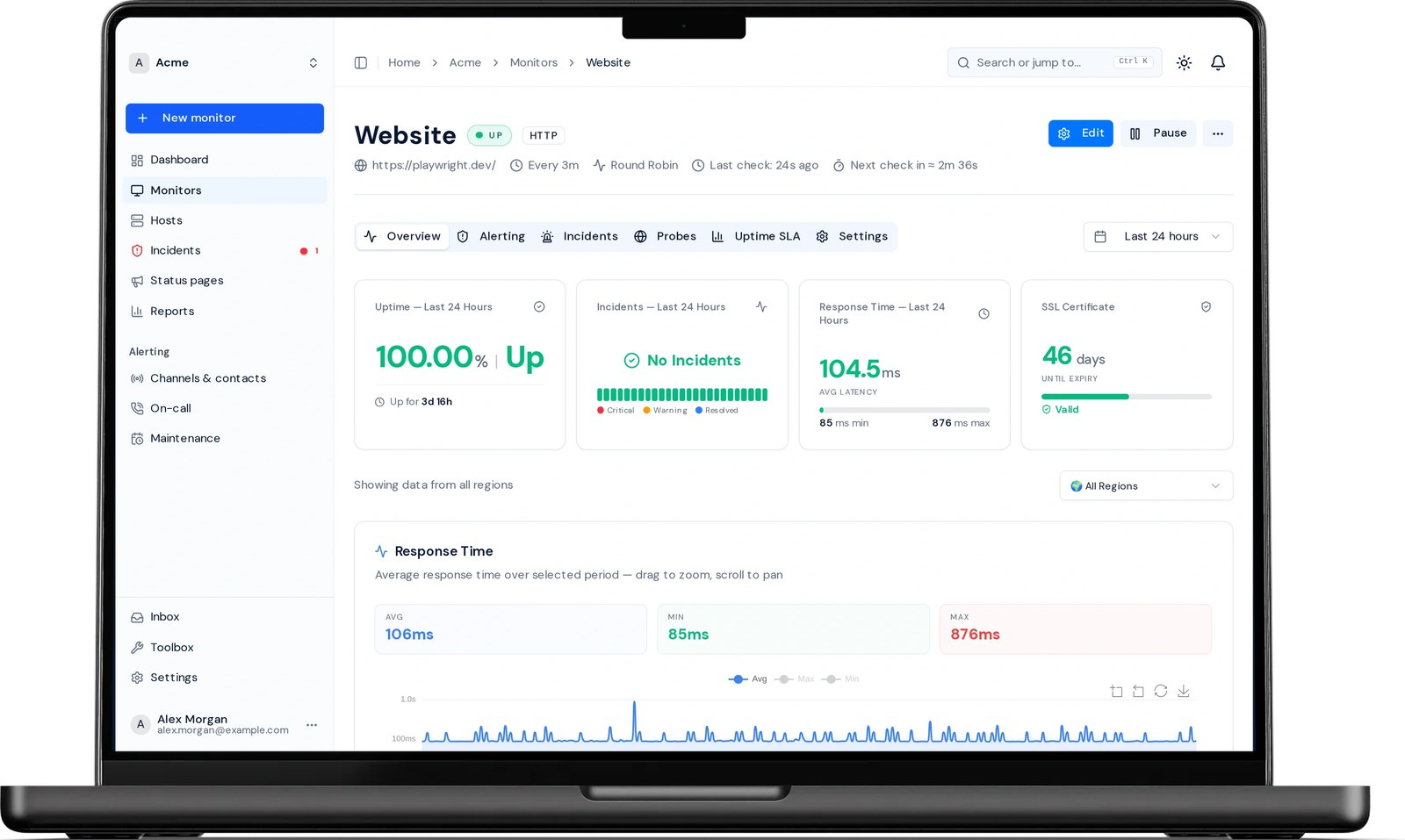
🖥️ WatchFor is an uptime and infrastructure monitoring service from Innospike UAB in Kaunas, Lithuania. It checks websites, APIs, SSL certificates, DNS, email, cron jobs, game servers and Linux servers, plus whole journeys such as signing in and paying, run in a real browser. A failure only counts as an outage once several locations confirm it; then alerts go out over 16 channels such as Slack, Teams, PagerDuty or Telegram, and on-call schedules, incident pages and public status pages hang off the same event. 🤖 Two things are aimed at AI: WatchFor can monitor MCP servers itself, and it offers its own MCP server with 77 tools. Through it, agents such as Claude, Cursor, Codex or VS Code can ask in plain language what is down, investigate incidents, create monitors and alert rules, or edit status pages. What an agent may do is bounded by the read or write scopes granted. 💶 The free plan needs no credit card; paid plans start at €7 a month plus VAT, according to the maker. The offer suits small teams and developers who would rather run their monitoring through an agent or a script than through a dashboard.
🔌 How the MCP server connects. According to the documentation the server sits at a fixed address over Streamable HTTP. Clients that implement MCP authorization sign in with OAuth 2.1: the browser opens a WatchFor consent screen, you choose read or write scopes, and any connected app can be revoked with one click in the account settings. An API key works too; a read key allows only the read tools. In Claude, WatchFor is listed in the connectors directory, the maker says, and Claude Code, Cursor and Codex get a plugin. It is the open-source agent-toolkit repository under the MIT licence, holds eleven agent skills written as plain Markdown instructions, and runs nothing locally, according to the maker.
🧰 What the tools do. One call returns a snapshot of all monitors, hosts, open incidents, maintenance windows and certificates and domains about to expire. Other tools return incident statistics with mean time to repair and between failures, reports compared with the previous period, monitors and alert rules to create and change, and diagnostics of a target from several regions. Each tool, the documentation says, wraps one or two REST API calls with the same permissions and rate limits, and is marked as read-only, changing or destructive so that a client can ask before risky actions. The maker also names gaps: some functions, such as editing maintenance windows or bulk actions, exist only in the REST API so far. A recent change lets agents manage status pages fully, including components, password and announcements; only the logo upload stays in the dashboard.
🧪 The monitoring itself. Browser checks run on Playwright, as your own code or recorded in Chrome, with step timings, Core Web Vitals and a full trace for every failure. An open-source agent for Linux servers reports CPU, memory, disk and network and only talks out over HTTPS. According to the maker's description WatchFor checks from 20 locations in 7 regions and offers a REST API with 101 operations, SDKs for TypeScript, Python and Ruby, and a Prometheus endpoint with a Grafana dashboard.
📊 What separates the plans. The pricing page lists four tiers. The free plan checks at most every three minutes from one region and covers 9 of the 31 check types; the bigger plans go down to 30 seconds, all regions and all check types. All 16 alert channels come with every plan, and the REST API is limited to 60 requests a minute. For companies with thousands of monitors Innospike offers custom plans. Teams that already run an established observability stack with logs mainly gain the agent connection here; anyone who monitors nothing yet can start free with a single check.