👪 TeenCue tells parents what their teen's AI chats are about, never what was typed
In brief
- 🧭 TeenCue tells parents what a teen's AI chats are about and how serious they look, but never shows the words.
- 🆘 Anything suggesting self-harm always triggers an alert at once, even at night.
- 💻 Runs as an extension for Chrome, Firefox, Edge and Brave and as an iPhone and iPad app; no Android.
- 💶 7 days free, then $79 a year or $9.99 a month.
🧭 [TeenCue](https://teencue.com/) is a parental control that does one thing: it watches teenagers' conversations with AI chatbots such as ChatGPT, Gemini, Claude or Character.AI. Instead of letting parents read the chats, it sorts each chat into a category and a topic and rates how concerning it looks. Parents see only that description, never the wording. When a chat on a topic the parent chose looks serious, an alert arrives by email or phone within minutes; anything that points to self-harm is always reported. A short weekly summary comes on top. According to the maker, TeenCue is deliberately not hidden: the teen knows it is running, and setup needs their computer. 💻 It works as a browser extension on computers and as an app on iPhone and iPad, not on Android. After seven free days it costs $79 a year or $9.99 a month.
⚙️ How it works. On a computer, the extension notices when the child sends a prompt to a supported AI service. According to the page [How TeenCue works](https://teencue.com/how-it-works), the text goes to the maker's backend and on to Anthropic, whose model returns the classification. One row is stored per chat: the service, a category from a fixed list (such as schoolwork, coding, personal advice, relationships or companionship), a more specific topic, a concern type with a severity from 0 to 3 (normal, low, moderate, significant), a confidence score and the time. The maker says the database has no column that could hold the text. Anthropic deletes the prompts within 30 days, TeenCue writes, except chats flagged for safety, which it may keep for up to two years, and their safety scores for up to seven.
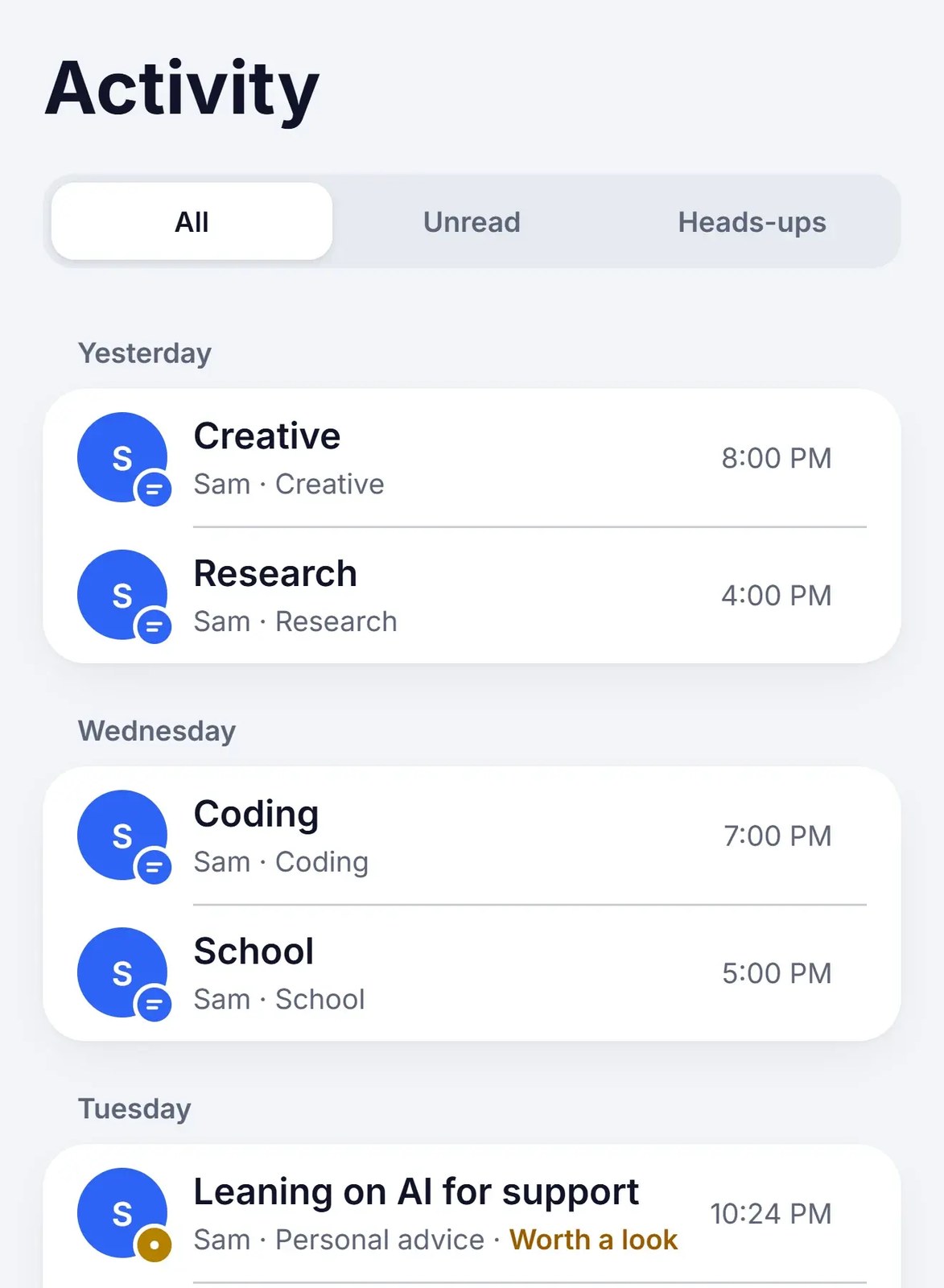
📋 What parents get. Chats rated moderate or above are grouped on the dashboard as worth a look. An immediate alert comes when a chat on one of up to three chosen topics is rated significant, and always when something suggests self-harm or that someone the child knows may be in danger. Between 9 PM and 7 AM a topic alert waits until morning on the phone; a self-harm alert does not. TeenCue stresses that it is not a crisis service and says itself that the classifier errs both ways: it misses things, and it may flag homework about a difficult novel.
🔍 Which services. The page lists ChatGPT, Gemini, Claude, Microsoft Copilot, Character.AI, Grok, DeepSeek, Perplexity and Poe; the Meta AI website is still being verified. Anything not on the list is invisible to TeenCue, including AI inside other apps such as Snapchat's My AI. According to the maker it does not record browsing history, other websites, keystrokes or screenshots.
📱 Devices. On computers TeenCue runs in Chrome, Firefox, Edge and Brave on macOS, Windows and Chromebooks, but not in Safari on a Mac. On iPhone and iPad the app uses Screen Time and a Safari extension on the child's Apple Account in Family Sharing: AI apps and other browsers are blocked so that AI chats happen in Safari. Families whose teen uses AI mainly on an Android phone are therefore outside its reach. Setup on a computer takes about five minutes, the maker says, and needs physical access to the device; it cannot be installed remotely.
🧩 What it is not for. TeenCue blocks nothing, filters no content and sets no screen-time limits. The maker presents it as an addition to Screen Time, Family Link or broad suites such as Bark and Qustodio, which show how long a child is online but not what an AI chat was about. Parents who want to read their child's messages are in the wrong place: that is explicitly impossible. TeenCue also recommends turning on the built-in parental controls of ChatGPT and Gemini.
💶 Price. Seven days on the teen's computer are free without a card, then $79 a year or $9.99 a month; in the iPhone app the annual plan is $79.99. Plans renew until cancelled. According to the founder's launch post, a single developer in California builds the product.